

only 1 left
When you start out into synths and synthesis, Bullfrog is worth every cent for the synth itself and the provided brilliant learning materials. You'll go home with lots of knowledge!Created by Erica Synths & Richie Hawtin, Bullfrog is an educational electronic music instrument designed to captivate and inspire both youth and professionals alike. Bullfrog invites you to unlock musicality while combining the thrill of electronic music production with a comprehensive learning experience.Bullfrog is a classical subtractive synthesizer - it consists of several “modules” for sound generation - VCO, NOISE GENERATOR - and treatment - VCF, VCA/DELAY, as well as “modules” that generate control and modulation signals to control them - ENVELOPE GENERATORS and SAMPLE & HOLD. The Bullfrog will not make the sound on its own unless it is patched - using eurorack patch cables to interconnect the “modules” or by inserting voice cards that create internal connections between the “modules” in a specific way and add extra functionality, like sampler/looper, sequencer, groovebox, etc. This approach better helps to understand the functionality of a subtractive synthesizer and the principles of sound design with instruments like these.What’s included:• BULLFROG synthesizer• Universal 12VDC wall wart adapter• User manual• 10 patch cables• 3 pre-patched voice cards: Sequencer, Acid Bassline, Sampler Looper• 3 DIY voice cardsIn order to provide a well-rounded understanding of the functionality of this synthesizer and sound synthesis in general, a comprehensive user manual is created to accompany the learning process. Use the buttons below to get to the project pages.Features:• Fully analogue design• Highly accurate voltage controlled oscillator (VCO) that tracks great over 8 octaves• Manually adjustable and voltage controlled waveshapes - sine-shark fin and pulse wave with pulse width modulation (PWM)• Zener diode-based noise generator• Resonant lowpass voltage controlled filter (VCF)• Voltage controlled amplifier (VCA) with adjustable offset• Delay effect with adjustable delay time and feedback amount• Two looping attack-sustain-release envelope generators (EG)• Sample & Hold circuit with an individual clock• Manual gate button• Voicecard slot• Built in speaker• DIN5 MIDI input• USB connector• Dimensions: 40 x 385 x 210 mm• Weight: 1.8 kg

available
An illustrated book that explains how to design a shift register-based drum sequencer from scratch. Starting with a single-button tap looper, it develops a rhythm composer with a clear button, metronome LED, accent and pitch CV outputs. Schematics, breadboard layouts and practical design challenges explain each stage. Based on the EDU DIY Drum Sequencer documentation, the book also covers assembly, troubleshooting, patching and circuit modifications. Experiments can use LABOR or a standard breadboard with a dual power supply or two 9V batteries. Electronic components are sourced separately.Features• Step-by-step shift register-based sequencer design• Schematics, breadboard layouts and browser-based simulations• Practical circuit design challenges• EDU DIY Drum Sequencer assembly and troubleshooting• Beat programming, LFO-based accents and melodic sequences• Modifications for tempo range, accent feel and melody conversion• Printed guide; electronic components are separate

only 2 left
This module is based around a BBD integrated circuit and allows for classic delay-based effects, from slapback echoes to trailing reverberations, from flanger-like sounds to crusty down-sampled madness.The module is DIY, sold as a kit by Erica Synths and comes with a very thorough assembly manual that provides deep insight into the functioning of every part of the circuit you'll build.The module itself features all your classic delay-related controls, from delay time to feedback amount, a dry/wet mix control and even a switch to select between 2 different delay ranges.A nice, surprising addition is a patch point labeled "Inhibit CV" which, whenever it is presented with a gate signal, will disconnect the clock signal from the BBD chip, essentially stopping the effect in its tracks. The clock will resume as soon as the gate goes low at this patch point, and the BBD circuit will then return to normal operation. This feature lets the player add some rhythm to the effect or perform other interesting shenanigans.We - Erica Synths and Moritz Klein - have developed a series of educational DIY kits under the brand name mki x es.EDU with one specific goal in mind: to teach people with little-to-no prior experience how to design analog synthesizer circuits from scratch. What you’ll find in the box is not simply meant to be soldered together and then disappear in your rack. Instead, we want to take you through the circuit design process step by step, explaining every choice we’ve made and how it impacts the finished module.NB! All kits in these series are simple and come with extensive user manuals which can be downloaded separately, therefore we will not provide customer support in case your DIY build fails to function or similar.DIY-Kit-Type:THT-Kit-1. This is a Do-It-Yourself kit, not an assembled module. The kit includes all parts to build the module. Only trough-hole parts to solder. Make sure to check the build guide before you buy. For build guide, more info, videos etc. please check the buttons below.

available
Need some professional polish in your modular system? With this simple diode-based compressor, you can shape the dynamics of your sound, adding punch and consistency to your patches. Whether you’re looking to beef up your basslines, add sustain to your leads, or tame the peaks of your percussion, this circuit’s got you covered.Erica Synths and Moritz Klein - have developed a series of educational DIY kits under the brand name mki x es.EDU with one specific goal in mind: to teach people with little-to-no prior experience how to design analog synthesizer circuits from scratch. What you’ll find in the box is not simply meant to be soldered together and then disappear in your rack. Instead, we want to take you through the circuit design process step by step, explaining every choice we’ve made and how it impacts the finished module.NB! All kits in these series are simple and come with extensive user manuals which can be downloaded separately, therefore we will not provide customer support in case your DIY build fails to function or similar.DIY-Kit-Type:THT-Kit-1. This is a Do-It-Yourself kit, not an assembled module. The kit includes all parts to build the module. Only trough-hole parts to solder. Make sure to check the build guide before you buy. For build guide, more info, videos etc. please check the buttons below.

sold out at the moment
The product is a front panel only.Replacement front panel with updated graphics for the Erica Synths EDU DIY Compressor. This is the Compressor variant of the new-design EDU DIY System Panels. It gives an existing Compressor module a consistent appearance alongside the KONSTRUKT-8 EDU DIY Drum System.Features• Compressor panel variant• Updated graphics for the EDU DIY Compressor• Matches the visual design of KONSTRUKT-8• 10 HP width; 3U Eurorack format• Front panel only; electronics are not included

available
EDU DIY Output Mixer 2 is an intermediate-level learning kit from the mki x es.EDU Drums System, created by Erica Synths and Moritz Klein. It teaches you how to build and understand a 4-channel Eurorack output mixer from scratch, starting on a breadboard and ending as a fully functional Eurorack module using the included PCB and panel.The circuit covers essential analog audio building blocks, including an inverting op-amp summing mixer, per-channel volume controls, a send/return loop, diode soft-clipping distortion and a headphone driver. The detailed illustrated manual explains each stage with clear diagrams and analogies, making the kit a practical way to learn how mixers, distortion circuits and headphone outputs work.Once assembled, EDU DIY Output Mixer 2 provides four input channels with individual level controls, per-channel sends, a return control, a variable distortion insert effect, plus line and headphone outputs. It is designed as a hands-on educational project for builders with basic electronics knowledge and previous DIY experience.All small components for the breadboard build are included, together with the Eurorack PCB, panel, power cable and a 40+ page digital manual. A breadboard, jumpers and a dual power supply are required separately. For a smoother learning experience, the kit can also be used with Labor, Erica Synths’ dedicated prototyping platform for EDU DIY learning kits.Features• Part of the mki x es.EDU Drums System by Erica Synths and Moritz Klein.• Breadboard learning build plus final Eurorack PCB and panel.• Four input channels with individual volume controls.• Send/return loop with per-channel send and return control.• Variable diode soft-clipping distortion.• Line output and headphone output.• Teaches op-amp summing, mixing, distortion and headphone driver design.DIY-Kit-TypeTHT-Kit-1. This is a Do-It-Yourself kit, not an assembled module. The kit includes all parts to build the module. Only trough-hole parts to solder. Make sure to check the build guide before you buy. For build guide, more info, videos etc. please check the buttons below.
available
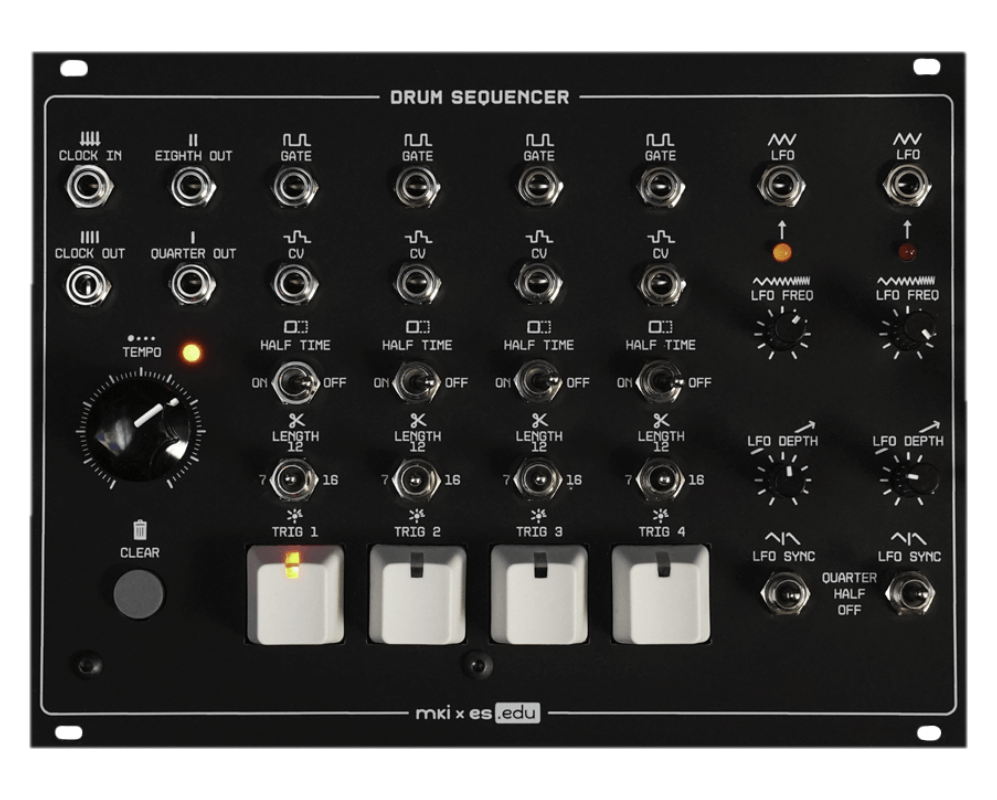
Most drum sequencers are complex machines crowded with buttons and LEDs. The mki x es.edu DIY Drum Sequencer kit takes a different path: a hands-on rhythm engine with a minimalist interface built from just a handful of logic chips. The four independent channels are programmed in real time using a single button, so patterns loop automatically, can be shortened on the fly and support half-time playback for slower, evolving grooves.Accents and dynamics are handled by synced LFOs, and a simple resistor DAC converts patterns into stepped control voltages – perfect for modulating pitch, decay, filter cutoff, or other parameters. This logic-chip sequencer delivers tactile, musical performance without relying on microcontrollers, making it an excellent DIY drum sequencer kit for learning sequencer design and sharpening soldering skills.Features:• 4 independent channels with one-button step input/removal• 16 steps per channel, individually reducible to 12 or 7• Optional half-time mode per channel• Two syncable analog LFOs for dynamic accents• Resistor-DAC output for pitch or decay modulation• Internal clock with 16th, 8th, and quarter note outputs, syncable to external gearDIY-Kit-Type:THT-Kit-1. This is a Do-It-Yourself kit, not an assembled module. The kit includes all parts to build the module. Only trough-hole parts to solder. Make sure to check the build guide before you buy. For build guide, more info, videos etc. please check the buttons below.

available
This is an easy to build Envelope Generator with a really extensive documentation and explanation of the circuit. Excellent learning kit!Many iconic sounds like the squelchy acid bass line, snappy techno kick drum, and swelling dream pop pad wouldn’t be possible if it weren’t for envelope generators. So, the next module in the mki x es.edu line is a slightly optimized ADSR envelope generator. Optimized because it has only 3 controls. With sustain on, it outputs an ASR (attack/sustain/release) envelope, but when the sustain is set to a minimum, it becomes an AD (attack/decay) envelope generator that ignores gate length; Release and Decay are controlled by the same knob. A looping function and an inverted output make the module more versatile for complex patches. The full EDU DIY system is designed to have 2 EG modules, therefore everyone aiming to build the whole system will need 2 kits.DIY-Kit-Type:THT-Kit-1. This is a Do-It-Yourself kit, not an assembled module. The kit includes all parts to build the module. Only trough-hole parts to solder. Make sure to check the build guide before you buy. For build guide, more info, videos etc. please check the buttons below.

available
This DIY module brings FM percussion to your Eurorack system, combining the raw power of analog circuits with the sharp, metallic tones of FM synthesis. From punchy kicks and deep toms to clangy, metallic hits, the mki x es.EDU FM Drum covers a wide range of percussive textures.Developed by Erica Synths and Moritz Klein as part of the educational mki x es.EDU series, this kit is designed not just for building, but for learning. It’s aimed at beginners and curious makers who want to understand analog synth design from the ground up.More than just a soldering project, this kit walks you through the full design process, explaining how each part of the circuit works and how sound is shaped, step by step.Features:• DIY FM drum voice – from kicks and toms to metallic clangs• Combines analog synthesis with FM-style sound shaping• Educational kit designed for beginners and learners• Part of the mki x es.EDU series by Erica Synths & Moritz Klein• Detailed build guide with circuit design explanations included• Inspires hands-on learning and deeper understanding of analog soundDIY-Kit-Type:THT-Kit-1. This is a Do-It-Yourself kit, not an assembled module. The kit includes all parts to build the module. Only trough-hole parts to solder. Make sure to check the build guide before you buy. For build guide, more info, videos etc. please check the buttons below.

only 1 left
The product is a front panel only.Replacement front panel with updated graphics for the Erica Synths EDU DIY Hi Hat. This is the Hi Hat variant of the new-design EDU DIY System Panels. It gives an existing Hi Hat module a consistent appearance alongside the KONSTRUKT-8 EDU DIY Drum System.Features• Hi Hat panel variant• Updated graphics for the EDU DIY Hi Hat• Matches the visual design of KONSTRUKT-8• 10 HP width; 3U Eurorack format• Front panel only; electronics are not included
available
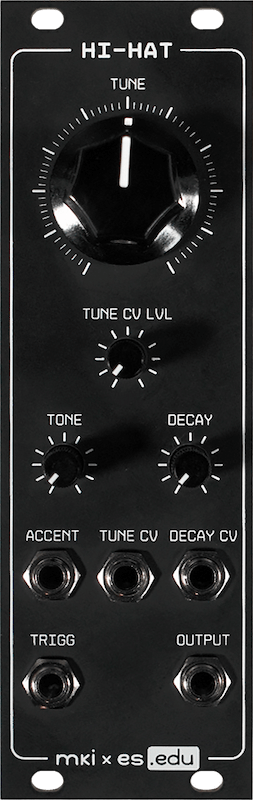
Synthesized, analog Hi-Hats are pretty fascinating. That’s because emulating any kind of cymbal using an analog circuit is tough since the sound a real cymbal produces is not quite pure noise, but also not really harmonic. Still, a couple of classic drum machines like the Roland TR-606 and TR-808 took their best shot at it, with quite strange-sounding results that have since become iconic in electronic music. Inspired by this, we decided to follow suit and continue our percussion-focused second season of educational DIY kits with the mki x es.edu DIY Hi-Hats.FeaturesFeatures:• TR-808 inspired circuit• Manual Tune, Decay and Tone controls• CV controlled Tune and Decay (-5V to +5V)• Accent input (>+2,5V)We – Erica Synths and Moritz Klein – have developed a series of educational DIY kits under the brand name mki x es.EDU with one specific goal in mind: to teach people with little-to-no prior experience how to design analog synthesizer circuits from scratch. What you’ll find in the box is not simply meant to be soldered together and then disappear in your rack. Instead, we want to take you through the circuit design process step by step, explaining every choice we’ve made and how it impacts the finished module.NB! All kits in these series are simple and come with extensive user manuals that can be downloaded separately, therefore we will not provide customer support in case your DIY build fails to function or similar.DIY-Kit-Type:THT-Kit-1. This is a Do-It-Yourself kit, not an assembled module. The kit includes all parts to build the module. Only trough-hole parts to solder. Make sure to check the build guide before you buy. For build guide, more info, videos etc. please check the buttons below.
sold out at the moment
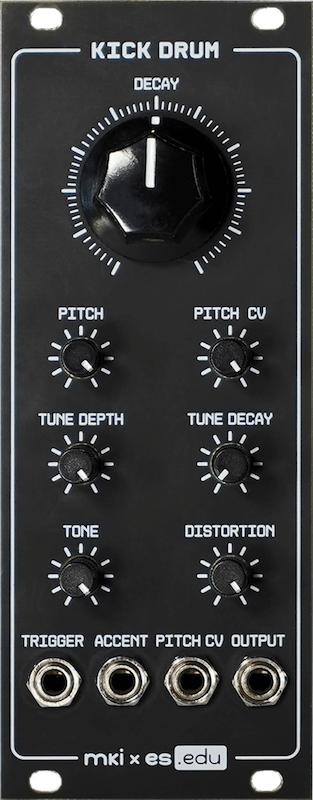
There’s nothing quite like the sound of old-school analog drum machines. Especially classic kicks like Roland’s 808 and 909 are ubiquitous in electronic music. Unfortunately, their circuitry is notoriously complex and difficult to understand. Enter the mki x es.edu DIY Kick Drum kit, which not only aims to shed some light on the fundamental circuit design principles behind those circuits - but also captures their unmistakable sound as a fully-fledged Eurorack module.We - Erica Synths and Moritz Klein - have developed a series of educational DIY kits under the brand name mki x es.EDU with one specific goal in mind: to teach people with little-to-no prior experience how to design analog synthesizer circuits from scratch. What you’ll find in the box is not simply meant to be soldered together and then disappear in your rack. Instead, we want to take you through the circuit design process step by step, explaining every choice we’ve made and how it impacts the finished module.NB! All kits in these series are simple and come with extensive user manuals which can be downloaded separately, therefore we will not provide customer support in case your DIY build fails to function or similar.Features:• Manual and CV controlled Pitch• Accent input• Manual decay control• Manual pitch envelope with adjustable depth and decay time• Tone control• Distortion controlDIY-Kit-Type:THT-Kit-1. This is a Do-It-Yourself kit, not an assembled module. The kit includes all parts to build the module. Only trough-hole parts to solder. Make sure to check the build guide before you buy. For build guide, more info, videos etc. please check the buttons below.

only 1 left
The product is a front panel only.Replacement front panel with updated graphics for the Erica Synths EDU DIY Kick Drum. This is the Kick drum variant of the new-design EDU DIY System Panels. It gives an existing Kick Drum module a consistent appearance alongside the KONSTRUKT-8 EDU DIY Drum System.Features• Kick drum panel variant• Updated graphics for the EDU DIY Kick Drum• Matches the visual design of KONSTRUKT-8• 10 HP width; 3U Eurorack format• Front panel only; electronics are not included

sold out at the moment
This is the Full Kit with a wide assortment of essential components (resistors, capacitors, ICs, transistors) so you can start building right away.Get started in circuit design with MKI x ES Labor. Developed in collaboration with Dr. Shalom D. Ruben teaching professor for engineering at the University of Colorado Labor is a fully-featured circuit design playground and a powerful electronics learning tool all in one. Created with the aim of serving as a universal learning tool for electronics engineering Labor enables users to delve into various aspects of electronics design from fundamental concepts to advanced techniques. Whether you're a beginner exploring the basics or an experienced engineer honing your skills Labor provides a versatile platform for experimentation and learning. Create your own filters oscillators envelopes sequencers – and whatever else you can come up with. Or use it to learn the basics by following along with our series of educational DIY kits.Features:• a built in dual power supply producing eurorack-compatible voltages, with built-in over current protection for safe experimenting• a modular interfacing section with 16 slots for potentiometers, jacks & switches• a pulse/triangle/sine oscillator (audio & LFO range)• a multi mode envelope generator controlled by a premium push button• a buffered variable control voltage source• an output amplifier with variable gain• a dedicated headphone output and a line-level output for recording, processing and analyzing the signal• an expansion slot for installing specialized prototyping tools• a protective lid to cover a breadboard.EDU DIY Labor Full Kit includes:• LABOR• Power Supply Unit• jumper cables• array of interfacing elements like potentiometers, jack sockets, switches• commonly used components (resistors, capacitors, chips, transistors) to start building circuits straight awayNB! LABOR is a testing ground for experiments with electronic circuits and we as a manufacturer cannot by any means diagnose any issues with circuits designed on the LABOR board. We will only respond to support tickets regarding obvious malfunctions of the factory-soldered circuits on the main LABOR board. For other cases of malfunction – please consult other LABOR users/ experienced DIY kit builders on online forums, such as this one. Keep experimenting – keep trying!DIY-Kit-Type:SMD-Kit-1. This is a Do-It-Yourself kit, not an assembled module. The kit includes all parts to build the module. All SMD parts are pre-soldered, only trough-hole parts to solder. For build guide, more info, videos etc. please check the buttons below.

available
A spare adapter PCB for potentiometers or jack sockets used with the Erica Synths EDU DIY Labor prototyping platform. It provides the mounting and electrical interface needed to connect a suitable control or socket to Labor’s modular interfacing section. The PCB is supplied separately; the desired component and pin headers must be fitted and soldered as described in the Labor manual.Features• Spare potentiometer/jack socket adapter PCB• Designed for EDU DIY Labor’s modular interfacing section• PCB only• Component and connector soldering required• Assembly instructions in the Labor manual

available
This PSU connector makes it easy to supply power to your Eurorack modules within the DIY.EDU Labor environment. It provides a simple interface for connecting modules to the Labor’s internal power distribution.Features:• Power connector for integrating Eurorack modules into the Labor• Compatible with the DIY.EDU Labor workspace• Simplifies prototyping and testing of powered modules• Compact and easy to installDIY-Kit-Type:THT-Kit-1. This is a Do-It-Yourself kit, not an assembled module. The kit includes all parts to build the module. Only trough-hole parts to solder. Make sure to check the build guide before you buy. For build guide, more info, videos etc. please check the buttons below.

available
This add-on expands the DIY.EDU Labor into a powerful, standalone electronics workstation. It integrates essential measurement and analysis tools, making it ideal for circuit development, debugging and learning within modular synthesis or general electronics.With an oscilloscope, voltmeter, spectrometer and tuner on board, this module gives you the insight and feedback you need to better understand your signals and modules in real time.Designed for educational use, prototyping, and experimentation.Features:• 3-channel oscilloscope – two external inputs, one internal (Labor audio out)• Visualizes Lissajous curves for waveform comparison• Voltmeter with 10V range and 0.1V resolution• Real-time spectrometer with adjustable display modes• Built-in chromatic tuner for pitch analysis and calibration• Turns the DIY.EDU Labor into a complete test & measurement stationDIY-Kit-Type:THT-Kit-1. This is a Do-It-Yourself kit, not an assembled module. The kit includes all parts to build the module. Only trough-hole parts to solder. Make sure to check the build guide before you buy. For build guide, more info, videos etc. please check the buttons below.

available
A spare adapter PCB for switches used with the Erica Synths EDU DIY Labor prototyping platform. It connects a suitable switch to Labor’s modular interfacing section, allowing switching functions to be added to experimental circuits. The PCB is supplied separately; the switch and pin headers must be fitted and soldered according to the Labor assembly instructions.Features• Spare switch adapter PCB• Designed for EDU DIY Labor’s modular interfacing section• PCB only• Switch and connector soldering required• Assembly instructions in the Labor manual

available
Mixing might be more of a utility function in a modular synthesizer – but this doesn’t necessarily mean it has to be dull and boring. Case in point: this super simple three-channel mixer with built-in diode distortion will make your patches sound delightfully rough.We – Erica Synths and Moritz Klein – have developed a series of educational DIY kits under the brand name mki x es.EDU with one specific goal in mind: to teach people with little-to-no prior experience how to design analog synthesizer circuits from scratch. What you’ll find in the box is not simply meant to be soldered together and then disappear in your rack. Instead, we want to take you through the circuit design process step by step, explaining every choice we’ve made and how it impacts the finished module.In total, we have developed 9 kits to build a fully-featured modular monosynth: a sequencer, a VCO, a wavefolder, a noise/S&H module, a mixer, a VCF, an Envelope generator, a dual VCA, and an output stereo mixer with a headphone amplifier. Additionally, an affordable eurorack case with a DIY PSU will also be available. While these kits are easy to build, we did not compromise on design and functionality. We will launch one kit every 4-6 weeks. For each kit, there is an extensive user manual (40+ pages; can be downloaded separately) that will dive deep into not only the electronics behind each circuit but also the fundamental principles of sound synthesis. We hope that the mki x es.EDU project will inspire future engineers and will contribute to the ever-growing diversity of electronic music technology.DIY-Kit-Type:THT-Kit-1. This is a Do-It-Yourself kit, not an assembled module. The kit includes all parts to build the module. Only trough-hole parts to solder. Make sure to check the build guide before you buy. For build guide, more info, videos etc. please check the buttons below.
available
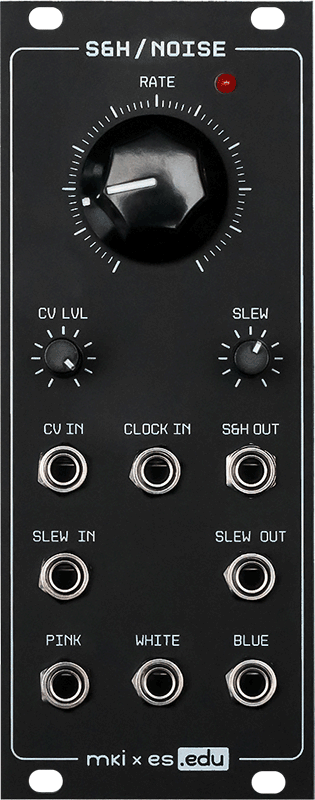
Whether you use it for self-sequencing, for adding a dash of randomness to your filter movements, or for rough analog bitcrushing, a sample & hold-circuit can often be the secret sauce that takes your patch from decent to distinctive. That’s why we came up with this super simple JFET-based implementation – and then upgraded it with a couple of extra features like an internal clock generator or a dedicated slew output. Of course, we’ll need an interesting input to sample – which is why you’ll often find sample & hold modules with an integrated noise generator. So we’ll do the same! But instead of just one noise color, we’ll throw in two extra: pink and blue in addition to the standard white noise.We – Erica Synths and Moritz Klein – have developed a series of educational DIY kits under the brand name mki x es.EDU with one specific goal in mind: to teach people with little-to-no prior experience how to design analog synthesizer circuits from scratch. What you’ll find in the box is not simply meant to be soldered together and then disappear in your rack. Instead, we want to take you through the circuit design process step by step, explaining every choice we’ve made and how it impacts the finished module.In total, we have developed 9 kits to build a fully-featured modular monosynth: a sequencer, a VCO, a wavefolder, a noise/S&H module, a mixer, a VCF, an Envelope generator, a dual VCA, and an output stereo mixer with a headphone amplifier. Additionally, an affordable eurorack case with a DIY PSU will also be available. While these kits are easy to build, we did not compromise on design and functionality. We will launch one kit every 4-6 weeks. For each kit, there is an extensive user manual (40+ pages; can be downloaded separately) that will dive deep into not only the electronics behind each circuit but also the fundamental principles of sound synthesis. We hope that the mki x es.EDU project will inspire future engineers and will contribute to the ever-growing diversity of electronic music technology.DIY-Kit-Type:THT-Kit-1. This is a Do-It-Yourself kit, not an assembled module. The kit includes all parts to build the module. Only trough-hole parts to solder. Make sure to check the build guide before you buy. For build guide, more info, videos etc. please check the buttons below.