
DIY Kits
sold out at the moment
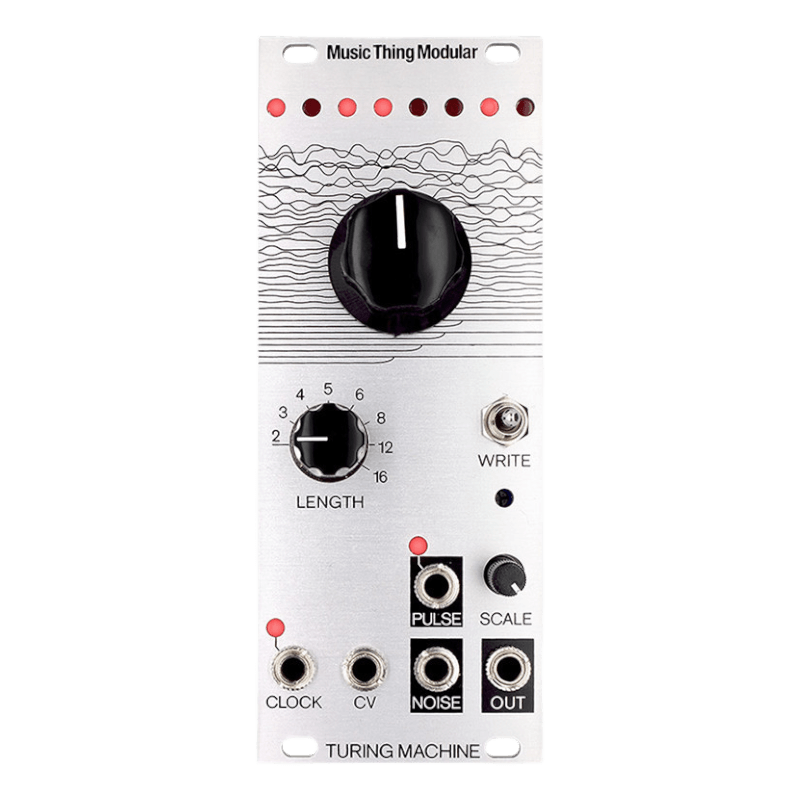
The Turing Machine is a binary sequencer based on a 16-bit shift register. Instead of precise programming, you steer its output.You can’t save or recall sequences—once changed, they’re gone.It generates clocked, stepped random control voltages (melodies, basslines, sequences) that can loop based on the length control.Since 2012, it’s been a popular Eurorack DIY project. Check #turingmachine on Instagram for demos.DivKid's 27-minute video explains it all, and here’s a 20-minute talk on its design.Sound on Sound Magazine published a nice review.Expanders connect to the module and modify sequences:• Volts: Extra voltage output controlled by five pots.• Pulses: Converts sequences into beats with 11 rhythmic outputs.• Voltages: Adds two CV outputs controlled by 8 faders.• Vactrol Mix: A matrix mixer for rhythmic audio cutting and panning.Looping is controlled by the big knob:• Noon = Random sequences.• 5 o’clock = Locked repeating sequence.• 7 o’clock = Double-length loop.• 3 or 9 o’clock = Loops with occasional changes.A free, virtual version exists in VCV Rack.Inspired by classic shift register synth circuits (Triadex Muse, Buchla 266, Noisering).Musically, it draws from 60s/70s minimalist composers like Steve Reich and Terry Riley.A Random Reading List covers its historical influences, from Marvin Minsky to Don Buchla.Open-source design has led to many clones and software versions (e.g., Mystic Circuits' Vert, VCV Rack modules, Mutable Instruments' Marbles).Despite the name, it’s not a true Turing Machine—just a looping data system.The original Mk1 documentation includes a detailed block diagram.It’s a dense but straightforward through-hole DIY build—better for experienced builders. Docs are on Thonk; troubleshooting on GitHub. DIY-Kit-Type:THT-Kit-1. This is a Do-It-Yourself kit, not an assembled module. The kit includes all parts to build the module. Only trough-hole parts to solder. Make sure to check the build guide before you buy. For build guide, more info, videos etc. please check the buttons below.

sold out at the moment
The Twin Drive is a 4 HP Drive/Distortion module inspired by the classic Minimoog input gain. Twin Drive is a stereo version of the Mini Drive, with left and right inputs – the left input is normalled to both outputs so the module can be used with mono signals as well. The Drive knob goes from zero/silent to lots of gain. It’s a dirty gain for modular level and works well with line level inputs – like a drum machine. It’s not suited as an external input for guitar.Using this module is a great way to make a polite sound source into something less polite, but always experiment with the levels! – the output can sound completely different depending on the settings and it can also be used to just add a nice bit of warmth to your input.While it doesn’t have CV in you can either put a VCA or a filter before to modify the amount of grime, or get more experimental and try blasting an LFO or a sequence into one input to see what it does to audio in the other input.DIY-Kit-Type:SMD-Kit-1. This is a Do-It-Yourself kit, not an assembled module. The kit includes all parts to build the module. All SMD parts are pre-soldered, only trough-hole parts to solder. For build guide, more info, videos etc. please check the buttons below.

sold out at the moment
• Vactrol Mix combines four audio or CV signals into two channels, determined by the random sequence. It’s a great way to create stereo effects, complex waveforms or feedback loops.• This expander is 4 in, 2 out vactrol matrix mixer controlled by the Turing Machine, connected around the back by a 16 pin ribbon cable.• There are four inputs, for audio or CV sources. The four knobs set the level for each input. Next to each knob is a pair of LEDs. When the LED on the left is lit, the signal goes to the left output. When the LED on the right is lit, the signal goes to the right output. The LEDs are controlled by the Turing Machine module. The two outputs are both doubled (mult-ed) to make it easier to patch feedback loops.• Despite being less popular or widespread than Pulses or Volts, this is my favourite Turing Machine expander. It is a unique device that turns mundane source material into wild, unpredictable but rhythmically accessible patterns of sound. It’s a great way to create stereo effects, shifting drones, complex waveforms or feedback loops, and can be the heart of small (but chaotic) system.• Vactrols are electro-optical devices; a light shining on a light-dependent resistor. They have an extraordinary history, from powering the optical soundtracks on the first sound films in the 1920s to studio compressors, the tremolo in Fender guitar amps, and many of Don Buchla's 1970s synth designs. Modern vactrols are an LED pointing at a cadmium light dependent resistor, sealed together in a little black plastic box. Because the LDR reacts relatively slowly, the signals cut together smoothly, with no clicks or pops. Unfortunately, the cadmium in light dependent resistors is banned in Europe, so Vactrols are becoming harder to find.• Feedback is where this module gets really interesting. Try sending the (bottom) left and right outputs to your output mixer, and the (top) left and right outputs to spring reverbs or delays, patching the delay/reverb outputs back into input channels. Carefully ride the input levels, and you'll get snippets of feedback. The main clock speed can have a huge effect on feedback levels, because it takes a while to build up.• There are lots of Vactrol Mix audio examples in my Soundcloud: Twenty Minutes of Madness, Contact Mic Feedback and this ancient track recorded using the breadboard prototype.• The Vactrol Mix is DC coupled, so you can also rhythmically cut up DC sources; mix LFOs at different speeds with audio rate oscilllators, and frequency modulating a pair of oscillators using the two outputs.• This module was inspired by Grant Richter's Cadavre Exquis voltage controlled mixer, which was inspired by André Breton's surrealist game Exquisite Corpse. Richter's mixer also inspired the RxMx module by Make Noise.• Jonathan Higgins, on Facebook: 'There isn't a patch I don't use it on. People often thing you can only use it for crazy stereo percussion (which it is amazing at). But I also often patch all four outputs from the humpback filter into it for evolving stereo drones.'• The Vactrol Mix is a very straightforward through-hole DIY build. If you get stuck, the Github Issue List is probably the best place to start - remember to check closed issues as well as open ones.DIY-Kit-Type:THT-Kit-1. This is a Do-It-Yourself kit, not an assembled module. The kit includes all parts to build the module. Only trough-hole parts to solder. Make sure to check the build guide before you buy. For build guide, more info, videos etc. please check the buttons below.

available
• CV expander with 8 faders.• This is an eight stage random looping sequencer with illuminated faders, controlled by the main Turing Machine. Unusually, any number of stages can be active at once, creating unpredictable results.• It has two outputs, one normal – with a scale control that works in the same was as the similar control on the main module – and one inverted. The inverted output has a ‘shift’ control which raises (offsets) the voltage by up to 9 volts. This means you can drive positive-only modules (i.e. quantizers) with the inverted output.• In some ways, this module has been replaced by the smaller Volts expander, but some people still enjoy it. It's bigger and more tactile, and the two outputs interact in interesting ways.• Volts is a shrunken version of the original Voltages expander, and was designed in one day while on holiday in Cornwall.• This module is compatible with all versions of the Turing Machine. With the older Mki Turing Machine the Backpack module is also required.• Voltages is a very straightforward through-hole DIY build, that would be a good first DIY project. If you get stuck, the Voltages Github Issue List or the main Turing Machine issue list are probably the best places to start, although very few people have ever had difficulty with this module.DIY-Kit-Type:THT-Kit-1. This is a Do-It-Yourself kit, not an assembled module. The kit includes all parts to build the module. Only trough-hole parts to solder. Make sure to check the build guide before you buy. For build guide, more info, videos etc. please check the buttons below.

sold out at the moment
• Tweak five potentiometers to set up another voltage output from the Turing Machine. This can be a different melodic sequence, related to but different from the main output.• This is a simple, low-parts count, low-current expander for the Turing Machine Random Sequencer in 4HP. It connects around the back with a 16-way ribbon cable and works with any Turing Machine (Mk2, or Mk1 with the backpack).• It acts like a variable 5-bit digital-to-analog converter, taking 5 bits from the Turing Machine GATES expansion port, running them through five potentiometers and giving one summed voltage output.• Multiple Volts expanders can be daisychained from one Turing sequencer to give melodically different outputs that are all related to (and change with) the main Turing sequence.• You can try out a fully operational Turing Machine + Pulses + Volts in the free VCV Rack software.• Volts is a shrunken version of the original Voltages expander, and was designed in one day while on holiday in Cornwall.• Volts is a very straightforward through-hole DIY build, that would be a good first DIY project. If you get stuck, the Volts Github Issue List or the main Turing Machine issue list are probably the best places to start, although very few people have ever had difficulty with this module.• Multiple VOLTS modules can be daisy-chained on a single Turing Machine to give a ‘polyphonic’ CV output.DIY-Kit-Type:THT-Kit-1. This is a Do-It-Yourself kit, not an assembled module. The kit includes all parts to build the module. Only trough-hole parts to solder. Make sure to check the build guide before you buy. For build guide, more info, videos etc. please check the buttons below.

available
Workshop Computer is a programmable Eurorack music computer from Music Thing Modular, designed to transform instantly through hot-swappable program cards. Inspired by early computer music studios such as EMS and Bell Labs, it brings algorithmic sequencing, audio effects, MIDI utilities and experimental sound generation into a compact 8HP module.The module ships with Reverb+, Turing Machine and Simple MIDI program cards, plus four blank cards ready to load with new programs from the growing open-source community library. Program cards can be swapped to completely change the module’s function, turning Workshop Computer into a stereo reverb, random looping sequencer, USB MIDI interface, utility processor or something entirely new.Workshop Computer features dedicated Audio/CV, pulse and precision CV inputs and outputs, three hands-on controls, a 3-way ON/OFF/MOMENTARY switch and six LEDs for clear visual feedback. The DIY build is approachable, with all surface-mount components pre-soldered; builders only need to install the pots, switches, sockets and LEDs.Powered by the RP2040 microcontroller, the same chip used in Raspberry Pi Pico, Workshop Computer is also open to coders and developers. Custom programs can be written in C/C++, Arduino Pico, CircuitPython, Lua and other RP2040-compatible environments, then loaded or updated via USB drag-and-drop. Compact, flexible and deeply expandable, Workshop Computer is a creative platform for effects, sequencing, MIDI, modulation and experimental Eurorack programming.Features• Programmable Eurorack music computer in 8HP.• Hot-swappable program cards for instant function changes.• Includes Reverb+, Turing Machine, Simple MIDI and 4 blank cards.• Growing free library of community-made program cards.• Audio/CV, pulse and precision CV inputs and outputs.• Three knobs, 3-way switch and six LED indicators.• RP2040-based platform compatible with C/C++, Arduino Pico, CircuitPython and Lua.• USB drag-and-drop program card updates.• Full DIY kit with SMD components pre-soldered.• 25mm depth and 175mA power consumption.DIY-Kit-Type:SMD-Kit-1. This is a Do-It-Yourself kit, not an assembled module. The kit includes all parts to build the module. All SMD parts are pre-soldered, only trough-hole parts to solder. For build guide, more info, videos etc. please check the buttons below.

available
The Workshop System is a complete modular synthesizer and audio computer – small enough to fit in a book-sized case, but packed with sound-shaping tools and educational potential. Designed for musicians, makers and tinkerers, it’s a fully modular playground for learning, composing, experimenting, and hacking.The system includes 14 analog and digital modules, ranging from vintage-style oscillators and filters to a programmable digital Computer module with swappable program cards. It works standalone inside its custom case or can be mounted in a Eurorack system (42 HP).You can use the system for crafting pure tones, exploring feedback loops, integrating guitar pedals, or writing your own firmware – the Workshop System invites hands-on discovery and creative exploration.Features:• Complete modular synth in a compact, case-mounted 42HP format• Includes 14 modules: oscillators, filters, mixer, ring mod, stompbox loop, envelope generators, and more• Powerful Computer module with RP2040 brain and reprogrammable program cards• Runs on USB-C (Power Delivery!) power (15 V) or standard Eurorack barrel input (15-25 V DC)• Works with audio sources, guitar pedals, microphones, and external MIDI/CV gear• Designed for experimentation, hacking, education – and serious music making The kit does not include:• Eurorack patch cables – we figure that many users of modular synths already have patch cables lying around – but if you’re just starting out and would like a set of short patch cables then we have a cable set available HERE• A power cable – The Workshop System has two power options: The easiest way is via USB-C PD power, but you can also use a regular 15-25 V DC barrel connection like THIS. The system will happily run from battery powerbanks and laptop adaptors. We feel that there are already enough USB-C cables in the world.DIY-Kit-Type:SMD-Kit-1. This is a Do-It-Yourself kit, not an assembled module. The kit includes all parts to build the module. All SMD parts are pre-soldered, only trough-hole parts to solder. For build guide, more info, videos etc. please check the buttons below.

available
Della is a compact 3 HP expander module for the Eurorack DIY version of Scrooge. It’s a fully passive breakout that provides individual outputs for all 8 sequencer tracks via dedicated sockets.The module connects to a header on the back of Scrooge and is designed specifically for the Eurorack version – this header is not accessible on the desktop unit.Features:• Eurorack expander for the Scrooge sequenced malfunction generator• Breaks out all 8 sequencer tracks via individual output sockets• Designed for the Eurorack version of Scrooge• Simple ribbon cable connection to back-panel header• Not compatible with the desktop version of ScroogeDIY-Kit-Type:SMD-Kit-1. This is a Do-It-Yourself kit, not an assembled module. The kit includes all parts to build the module. All SMD parts are pre-soldered, only trough-hole parts to solder. For build guide, more info, videos etc. please check the buttons below.

available
Elmyra 2 is a 4-voice digital/analog hybrid platform for microtonal sonic exploration, capable of creating anything from lush ambient soundscapes to gritty droning textures and shrieking noises, available as a 42 HP Eurorack module or semi-modular desktop synth. With 31 modulation targets, 4 polymetric sequencers, delay, additional per-voice effects, a choice of various filters, as well as onboard LFOs and utilities, it is essentially a purpose-built small modular system in itself. A set of preset cards (included) or electronic components like capacitors or diodes can be plugged into the front panel in order to change the sound character.Features:• 4 independent voices activated by touch or CV• wavetable-based complex oscillator engine, up to 12 oscillators in total, 1V/octave compatible• chromatic mode makes chords and harmonic sounds possible, microtonal scales supported• 41 patch points• 31 modulation targets• touchpads with analog envelopes that can be used as modulation sources• resonant filter switchable between:• boomy and aggressive multimode 2-pole state variable filter (low-pass, band-pass, high-pass)• creamy 4-pole low-pass ladder filter• delay with unhealthy amounts of feedback• lo-fi reverb• analog OUCH circuit: a unique combination of destructive distortion, waveshaping and filtering• sonic character can be customised by using special preset cards (set of 4 included) or components like diodes that can be plugged into the front panel• preset cards can be used with other Neutral Labs modules• external audio can be processed via audio input• 9 per-voice modulations and effects:• unison detune• dual sub-oscillators• saturation• bitmangler• sample rate reduction• noise• high-pass filter• low-pass filter• 2 LFOs: 1 sine, 1 complex morphable• 4 sequencers with arbitrary step length per voice (up to 128), allows polymetric structures• delay time and LFOs can be clock-synced or unsynced (tap tempo is also possible)• utilities• dual attenuator/buffered multiple/voltage generator• CV summing circuit• solid bamboo wood case• boutique synth handmade in GermanyDIY-Kit-Type:SMD-Kit-1. This is a Do-It-Yourself kit, not an assembled module. The kit includes all parts to build the module. All SMD parts are pre-soldered, only trough-hole parts to solder. For build guide, more info, videos etc. please check the buttons below.

available
Elmyra 2 is a 4-voice digital/analog hybrid platform for microtonal sonic exploration, capable of creating anything from lush ambient soundscapes to gritty droning textures and shrieking noises, available as a 42 HP Eurorack module or semi-modular desktop synth. With 31 modulation targets, 4 polymetric sequencers, delay, additional per-voice effects, a choice of various filters, as well as onboard LFOs and utilities, it is essentially a purpose-built small modular system in itself. A set of preset cards (included) or electronic components like capacitors or diodes can be plugged into the front panel in order to change the sound character.Features:• 4 independent voices activated by touch or CV• wavetable-based complex oscillator engine, up to 12 oscillators in total, 1V/octave compatible• chromatic mode makes chords and harmonic sounds possible, microtonal scales supported• 41 patch points• 31 modulation targets• touchpads with analog envelopes that can be used as modulation sources• resonant filter switchable between:• boomy and aggressive multimode 2-pole state variable filter (low-pass, band-pass, high-pass)• creamy 4-pole low-pass ladder filter• delay with unhealthy amounts of feedback• lo-fi reverb• analog OUCH circuit: a unique combination of destructive distortion, waveshaping and filtering• sonic character can be customised by using special preset cards (set of 4 included) or components like diodes that can be plugged into the front panel• preset cards can be used with other Neutral Labs modules• external audio can be processed via audio input• 9 per-voice modulations and effects:• unison detune• dual sub-oscillators• saturation• bitmangler• sample rate reduction• noise• high-pass filter• low-pass filter• 2 LFOs: 1 sine, 1 complex morphable• 4 sequencers with arbitrary step length per voice (up to 128), allows polymetric structures• delay time and LFOs can be clock-synced or unsynced (tap tempo is also possible)• utilities• dual attenuator/buffered multiple/voltage generator• CV summing circuit• case made of plant-based bioplastic and native German oakwood• boutique synth handmade in GermanyDIY-Kit-Type:SMD-Kit-1. This is a Do-It-Yourself kit, not an assembled module. The kit includes all parts to build the module. All SMD parts are pre-soldered, only trough-hole parts to solder. For build guide, more info, videos etc. please check the buttons below.

available
This is the DIY Desktop version of this unit.Logic, Unbound. Meet Luna. The first serious Lunetta synthesizer.Look beyond clean waveforms and predictable polyphony. Luna takes you back to a time when digital didn’t mean perfect. It meant raw. Inspired by the subterranean DIY culture of the 70s and 80s, Luna is a love letter to the Lunetta machines of old – living, breathing organisms built from CMOS logic chips. But where those machines were fragile experiments, Luna is a weaponised instrument of sonic confusion.The Nervous System Exposed. True to the Neutral Labs philosophy, we don’t believe in hiding the magic behind an opaque faceplate. Luna features exposed CMOS inputs and outputs directly on the front panel. You're not simply patching cables – you are rewiring the brain of the synthesizer itself. Combine signals, bend logic, and physically intervene in the computation to create sounds that shouldn’t exist.Rhythm is Timbre. Timbre is Rhythm. In the world of Luna, there is no difference between a sequencer and an oscillator. The same digital pulse that drives a bass line can be accelerated into a screeching lead or folded into a metallic drone.Five oscillators provide the raw material. A chaotic array of logic blocks (XOR, NOT, AND, shift registers, counters, multiplexer) chews up those signals and spits out complex, evolving mathematical noise.Taming the Digital Mess. Raw logic can be harsh. To turn this binary chaos into music, Luna feeds its digital soul through three organic low-pass gates. These analogue circuits impart a natural decay and percussive punch to the madness, transforming mathematical errors into bongos, plucks, and thumping basslines.Drench it in Atmosphere. Once you’ve constructed your signal, destroy it again. Luna comes equipped with a suite of effects – distortion, delay, reverb, chorus, bitcrusher, phaser and more – to smear your logic into a wash of ambient bliss or gritty industrial texture.Features:• 5 oscillators• Logic gates (2 XOR, 2 NOT, 2 AND)• 5 logic blocks (5-step ring counter, 4-bit binary counter, 2 shift registers, 4-channel multiplexer)• 3 touchpads that generate logic signals• 3 channels for audio manipulation (low-pass gates with adjustable decay and switchable trigger mode, gain, tilt EQ)• 13 audio effects freely assignable to 2 effect slots running in series (drive, delay, reverb, 6 filter types, bitcrusher, phaser, chorus, comb filter)• CV control for effects and 2 oscillators• MIDI control over 2 oscillators, all 3 low-pass gates, and 3 logic outputs• 2 sequencers with up to 64 steps, syncable to clock or MIDI• Headphone-compatible audio outputDIY-Kit-Type:SMD-Kit-1. This is a Do-It-Yourself kit, not an assembled module. The kit includes all parts to build the module. All SMD parts are pre-soldered, only trough-hole parts to solder. For build guide, more info, videos etc. please check the buttons below.

only 2 left
This is the DIY Eurorack version of this unit.Logic, Unbound. Meet Luna. The first serious Lunetta synthesizer.Look beyond clean waveforms and predictable polyphony. Luna takes you back to a time when digital didn’t mean perfect. It meant raw. Inspired by the subterranean DIY culture of the 70s and 80s, Luna is a love letter to the Lunetta machines of old – living, breathing organisms built from CMOS logic chips. But where those machines were fragile experiments, Luna is a weaponised instrument of sonic confusion.The Nervous System Exposed. True to the Neutral Labs philosophy, we don’t believe in hiding the magic behind an opaque faceplate. Luna features exposed CMOS inputs and outputs directly on the front panel. You're not simply patching cables – you are rewiring the brain of the synthesizer itself. Combine signals, bend logic, and physically intervene in the computation to create sounds that shouldn’t exist.Rhythm is Timbre. Timbre is Rhythm. In the world of Luna, there is no difference between a sequencer and an oscillator. The same digital pulse that drives a bass line can be accelerated into a screeching lead or folded into a metallic drone.Five oscillators provide the raw material. A chaotic array of logic blocks (XOR, NOT, AND, shift registers, counters, multiplexer) chews up those signals and spits out complex, evolving mathematical noise.Taming the Digital Mess. Raw logic can be harsh. To turn this binary chaos into music, Luna feeds its digital soul through three organic low-pass gates. These analogue circuits impart a natural decay and percussive punch to the madness, transforming mathematical errors into bongos, plucks, and thumping basslines.Drench it in Atmosphere. Once you’ve constructed your signal, destroy it again. Luna comes equipped with a suite of effects – distortion, delay, reverb, chorus, bitcrusher, phaser and more – to smear your logic into a wash of ambient bliss or gritty industrial texture.Features:• 5 oscillators• Logic gates (2 XOR, 2 NOT, 2 AND)• 5 logic blocks (5-step ring counter, 4-bit binary counter, 2 shift registers, 4-channel multiplexer)• 3 touchpads that generate logic signals• 3 channels for audio manipulation (low-pass gates with adjustable decay and switchable trigger mode, gain, tilt EQ)• 13 audio effects freely assignable to 2 effect slots running in series (drive, delay, reverb, 6 filter types, bitcrusher, phaser, chorus, comb filter)• CV control for effects and 2 oscillators• MIDI control over 2 oscillators, all 3 low-pass gates, and 3 logic outputs• 2 sequencers with up to 64 steps, syncable to clock or MIDI• Headphone-compatible audio outputDIY-Kit-Type:SMD-Kit-1. This is a Do-It-Yourself kit, not an assembled module. The kit includes all parts to build the module. All SMD parts are pre-soldered, only trough-hole parts to solder. For build guide, more info, videos etc. please check the buttons below.

sold out at the moment
Meg is a unique kind of waveshaper. Instead of folding the wave back in on itself like a common wavefolder, it shifts parts of the wave up or down, with the shifting threshold being adjustable. The resulting 2 half-waves can be flattened one by one, essentially morphing into a half square wave and eventually a full square wave. Essentially, it will add pulse-width modulation (and more) to any kind of wave. Both knobs can be fully CV controlled.DIY-Kit-Type:THT-Kit-1. This is a Do-It-Yourself kit, not an assembled module. The kit includes all parts to build the module. Only trough-hole parts to solder. Make sure to check the build guide before you buy. For build guide, more info, videos etc. please check the buttons below.

sold out at the moment
Nermal is discontinued for now - sorry. Nermal is a destructive distortion Eurorack module that has some unique sonic qualities. There are 3 levels of distortion ranging from subtle saturation to utter destruction. An integrated modulator can switch or even blend between these modes, with the modulation frequency going well into the audio range, in which case, interesting harmonics and artefacts can be created on top of the incoming audio. Nermal rewards experimentation and unexpected sweetspots can often be discovered along the way. In addition to the onboard modulator, there are external modulation options via control voltages (CV) for the most commonly used parameters. LFOs and envelopes work great, but audio signals are accepted as well and make for the most interesting patches.DIY-Kit-Type:THT-Kit-1. This is a Do-It-Yourself kit, not an assembled module. The kit includes all parts to build the module. Only trough-hole parts to solder. Make sure to check the build guide before you buy. For build guide, more info, videos etc. please check the buttons below.

sold out at the moment
A 4 HP distortion module that allows the flavour of the sound to be changed by separately available preset cards, or even just individual components that can be plugged directly onto the front panel, like diodes, capacitors and resistors. Maybe you would want to try an LED combined with a photoresistor? The cards (Product name: Nuts) are also compatible with the Scrat VCF module.DIY-Kit-Type:SMD-Kit-1. This is a Do-It-Yourself kit, not an assembled module. The kit includes all parts to build the module. All SMD parts are pre-soldered, only trough-hole parts to solder. For build guide, more info, videos etc. please check the buttons below.

sold out at the moment
Nuts is a set of four preset cartridges for Neutral Labs Scrat and Nijel. They give you instant access to a variety of filter sounds. Please read the Scrat manual to get a detailed explanation about how it works. Elmyra 2 has different preset cards, but they should also work with Scrat and Nijel.

sold out at the moment
Pip contains two morphable CV generators/complex LFOs in 8 HP that can be synced to each other in predefined ratios, unsynced or phase-shifted between each other. You can choose from a large variety of preset waveforms, random waves or even record and morph your own external CV or knob movements.DIY-Kit-Type:SMD-Kit-1. This is a Do-It-Yourself kit, not an assembled module. The kit includes all parts to build the module. All SMD parts are pre-soldered, only trough-hole parts to solder. For build guide, more info, videos etc. please check the buttons below.

sold out at the moment
Scrat - user customizable Steiner-Parker filter. Scrat is an aggressive sounding multimode Steiner-Parker filter with a twist: You can change the resonance response by plugging in components like diodes, capacitors or resistors (even LEDs and/or light-dependent resistors) directly to the front panel. A set of preset cartridges is also available, which gives you instant access to a variety of filter sounds. You could even make your own. Or go all in and connect some jumper wires to a breadboard for pretty much endless possibilities.The 2-pole filter (12 dB/octave) supports both high-pass and low-pass mode. Even without external components or cartridges, the resonance behaviour can be changed in various ways via switches on the front panel. A set of 4 preset cards called Nuts (Acorn, Almond, Cashew and Pecan) is also available.Both resonance and cutoff can be fully CV controlled, and the cutoff CV sensitivity can be adjusted as well. The module contains an adjustable pre-filter drive circuit, which pairs very well with the Steiner-Parker design.DIY-Kit-Type:THT-Kit-1. This is a Do-It-Yourself kit, not an assembled module. The kit includes all parts to build the module. Only trough-hole parts to solder. Make sure to check the build guide before you buy. For build guide, more info, videos etc. please check the buttons below.

available
This is the DIY Desktop version of this unit with black panel.Scrooge is a sequenced malfunction generator, available as a 42 HP Eurorack module or semi-modular desktop synth. While you can convince it to deliver boomy kick drum sounds, clicky hi-hats or metallic snares, it would much rather be making glitchy artifacts, hollow crackles and horribly distorted growls. It contains a sophisticated and performance-oriented step sequencer with parameter locking and the possibility to control all steps across multiple tracks at once. Its 5 distinct and fully analog voices are made up of special circuits that work without dedicated power supplies, scrounging power from the sequencer control signals instead, which gives them an organic and unstable quality. As a bonus, it means you won’t have to power the unit itself if you sequence it from external gear.Features:• 5 distinct analog voices• device can work passively without a power supply if sequenced from external gear• each voice can be routed to either of 2 main outputs (headphone compatible)• individual voice outputs• individual voice CV inputs that respond well to audio signals• 2 modulation tracks, individually routable to voices• 2 modulation CV inputs• onboard step sequencer * parameter locking per step * "control all" mode (change parameters for several steps and tracks at once), great for interactive playing * arbitrary step length per track (up to 64 steps) * generative algorithm builds random variations on patterns (available while performing), or creates random patterns from scratch * pattern chaining (up to 32 patterns) * stores up to 128 patterns in 16 banks * microtiming * CV slew limiter per track• can sequence external gear• sync output• sync and reset inputs• MIDI input (TRS type A)• Bamboo wood caseDIY-Kit-Type:SMD-Kit-1. This is a Do-It-Yourself kit, not an assembled module. The kit includes all parts to build the module. All SMD parts are pre-soldered, only trough-hole parts to solder. For build guide, more info, videos etc. please check the buttons below.

sold out at the moment
This is the DIY Eurorack version of this unit with black panel.Scrooge is a sequenced malfunction generator, available as a 42 HP Eurorack module or semi-modular desktop synth. While you can convince it to deliver boomy kick drum sounds, clicky hi-hats or metallic snares, it would much rather be making glitchy artifacts, hollow crackles and horribly distorted growls. It contains a sophisticated and performance-oriented step sequencer with parameter locking and the possibility to control all steps across multiple tracks at once. Its 5 distinct and fully analog voices are made up of special circuits that work without dedicated power supplies, scrounging power from the sequencer control signals instead, which gives them an organic and unstable quality. As a bonus, it means you won’t have to power the unit itself if you sequence it from external gear.Features:• 5 distinct analog voices• device can work passively without a power supply if sequenced from external gear• each voice can be routed to either of 2 main outputs (headphone compatible)• individual voice outputs• individual voice CV inputs that respond well to audio signals• 2 modulation tracks, individually routable to voices• 2 modulation CV inputs• onboard step sequencer * parameter locking per step * "control all" mode (change parameters for several steps and tracks at once), great for interactive playing * arbitrary step length per track (up to 64 steps) * generative algorithm builds random variations on patterns (available while performing), or creates random patterns from scratch * pattern chaining (up to 32 patterns) * stores up to 128 patterns in 16 banks * microtiming * CV slew limiter per track• can sequence external gear• sync output• sync and reset inputs• MIDI input (TRS type A)DIY-Kit-Type:SMD-Kit-1. This is a Do-It-Yourself kit, not an assembled module. The kit includes all parts to build the module. All SMD parts are pre-soldered, only trough-hole parts to solder. For build guide, more info, videos etc. please check the buttons below.