
Modular

only 1 left
The Pingable Envelope Generator (PEG) from 4ms is a dual envelope generator whose envelope lengths are set by incoming clocks or "pings".The PEG has full CV control of envelope shape, skew, and ping (clock) division/multiplication, as well as a plethora of triggering and cycling options (AD, AR, quantization, cycle), and a tap tempo button for each channel.DIY-Kit-Type:THT-Kit-1. This is a Do-It-Yourself kit, not an assembled module. The kit includes all parts to build the module. Only trough-hole parts to solder. Make sure to check the build guide before you buy. For build guide, more info, videos etc. please check the buttons below.

sold out at the moment
The Pingable Envelope Generator (PEG) from 4ms is a dual envelope generator whose envelope lengths are set by incoming clocks or "pings".The PEG has full CV control of envelope shape, skew, and ping (clock) division/multiplication, as well as a plethora of triggering and cycling options (AD, AR, quantization, cycle), and a tap tempo button for each channel.DIY-Kit-Type:THT-Kit-1. This is a Do-It-Yourself kit, not an assembled module. The kit includes all parts to build the module. Only trough-hole parts to solder. Make sure to check the build guide before you buy. For build guide, more info, videos etc. please check the buttons below.

available
The QCD Expander is an expansion module for the Quad Clock Distributor (QCD).The QCD Expander adds a host of features, turning the QCD into a programmatic non-linear sequencer. Each channel gets a CV Trigger Delay (Pulse Width) jack and knob, an additional output jack with three selectable modes, and attenuverters for all CV input jacks. Self-patched evolving rhythms and swing/shuffle patterns are easily obtained, as well as complete control over standard rhythmic patterns.DIY-Kit-Type:THT-Kit-1. This is a Do-It-Yourself kit, not an assembled module. The kit includes all parts to build the module. Only trough-hole parts to solder. Make sure to check the build guide before you buy. For build guide, more info, videos etc. please check the buttons below.

only 2 left
The QCD Expander is an expansion module for the Quad Clock Distributor (QCD).The QCD Expander adds a host of features, turning the QCD into a programmatic non-linear sequencer. Each channel gets a CV Trigger Delay (Pulse Width) jack and knob, an additional output jack with three selectable modes, and attenuverters for all CV input jacks. Self-patched evolving rhythms and swing/shuffle patterns are easily obtained, as well as complete control over standard rhythmic patterns.DIY-Kit-Type:THT-Kit-1. This is a Do-It-Yourself kit, not an assembled module. The kit includes all parts to build the module. Only trough-hole parts to solder. Make sure to check the build guide before you buy. For build guide, more info, videos etc. please check the buttons below.

available
The Quad Pingable LFO (QPLFO) is a compact, playable four-channel tap-tempo, clock-syncable LFO with variable skew and reset.The QPLFO is designed to be useful in small portable systems that require maximum functionality in minimal space, as well as large systems that need maximum modulation sources.Features:• Quad "pingable" LFO's -- frequency is set by time between pulses ("ping")• Each of the 4 channels is an independent LFO• Can produce a variety of waveshapes: "Pluck," to ramp-down, to triangle, to ramp-up, and all shapes in between• Channels can easily modulate, trigger, and reset each other for complex and slowly morphing outputs• Slowest period is about 71 minutes (0.0002 Hz), fastest speed is about 500Hz (marginal tracking up to 1kHz)• Tap tempo button is free-running (LFO runs indefinitely), but external clock/Ping is auto-stopping (LFO stops when external clock stops)DIY-Kit-Type:THT-Kit-1. This is a Do-It-Yourself kit, not an assembled module. The kit includes all parts to build the module. Only trough-hole parts to solder. Make sure to check the build guide before you buy. For build guide, more info, videos etc. please check the buttons below.

only 1 left
The Quad Pingable LFO (QPLFO) is a compact, playable four-channel tap-tempo, clock-syncable LFO with variable skew and reset.The QPLFO is designed to be useful in small portable systems that require maximum functionality in minimal space, as well as large systems that need maximum modulation sources.Features:• Quad "pingable" LFO's -- frequency is set by time between pulses ("ping")• Each of the 4 channels is an independent LFO• Can produce a variety of waveshapes: "Pluck," to ramp-down, to triangle, to ramp-up, and all shapes in between• Channels can easily modulate, trigger, and reset each other for complex and slowly morphing outputs• Slowest period is about 71 minutes (0.0002 Hz), fastest speed is about 500Hz (marginal tracking up to 1kHz)• Tap tempo button is free-running (LFO runs indefinitely), but external clock/Ping is auto-stopping (LFO stops when external clock stops)DIY-Kit-Type:THT-Kit-1. This is a Do-It-Yourself kit, not an assembled module. The kit includes all parts to build the module. Only trough-hole parts to solder. Make sure to check the build guide before you buy. For build guide, more info, videos etc. please check the buttons below.

only 2 left
The RCD Breakout adds features to the Rotating Clock Divider module.Six switches allow you to set the maximum Divide-by amount, Gate or Trigger mode, Counting mode, Spread mode, and Auto-Reset. The RCD Breakout requires the RCD to function, and does not use any extra power.DIY-Kit-Type:THT-Kit-1. This is a Do-It-Yourself kit, not an assembled module. The kit includes all parts to build the module. Only trough-hole parts to solder. Make sure to check the build guide before you buy. For build guide, more info, videos etc. please check the buttons below.

sold out at the moment
The RCD Breakout adds features to the Rotating Clock Divider module.Six switches allow you to set the maximum Divide-by amount, Gate or Trigger mode, Counting mode, Spread mode, and Auto-Reset. The RCD Breakout requires the RCD to function, and does not use any extra power.DIY-Kit-Type:THT-Kit-1. This is a Do-It-Yourself kit, not an assembled module. The kit includes all parts to build the module. Only trough-hole parts to solder. Make sure to check the build guide before you buy. For build guide, more info, videos etc. please check the buttons below.

only 1 left
The Rotating Clock Divider (RCD) produces eight divided clock tempos from a single input clock. The divisions range from /1 to /64, including all odd and non-standard divisions such as /3 and /17 and /62. A Rotate CV input re-assigns the division number of each jack, allowing for creative mix-ups and experimentation. A Reset input jack helps to sync/start with an external clock.Features:• Divide-by-1 to Divide-by-64, on 8 output jacks• CV Rotate jack to shift divide-by amount on each jack• CV Reset jack to reset/re-sync all jacks• Optional break-out panels to expand functionality (Auto-reset, selectable Divide-by range, Gate/Trigger, Up/Down-counting)DIY-Kit-Type:THT-Kit-1. This is a Do-It-Yourself kit, not an assembled module. The kit includes all parts to build the module. Only trough-hole parts to solder. Make sure to check the build guide before you buy. For build guide, more info, videos etc. please check the buttons below.

sold out at the moment
The Rotating Clock Divider (RCD) produces eight divided clock tempos from a single input clock. The divisions range from /1 to /64, including all odd and non-standard divisions such as /3 and /17 and /62. A Rotate CV input re-assigns the division number of each jack, allowing for creative mix-ups and experimentation. A Reset input jack helps to sync/start with an external clock.Features:• Divide-by-1 to Divide-by-64, on 8 output jacks• CV Rotate jack to shift divide-by amount on each jack• CV Reset jack to reset/re-sync all jacks• Optional break-out panels to expand functionality (Auto-reset, selectable Divide-by range, Gate/Trigger, Up/Down-counting)DIY-Kit-Type:THT-Kit-1. This is a Do-It-Yourself kit, not an assembled module. The kit includes all parts to build the module. Only trough-hole parts to solder. Make sure to check the build guide before you buy. For build guide, more info, videos etc. please check the buttons below.

available
The Sampler plays stereo or mono .wav files from an SD Card. Samples are arranged into banks by placing .wav files into folders (each folder is a bank). A maximum of 10 samplers can be loaded in a bank, and there is a maximum of 60 bank (600 samples maximum total). Sample files are limited to 4GB each, which is over 6 hours at 44k/16b/stereo.• Hundreds of samples included on microSD card• Extremely quiet, low noise and low jitter design• Stereo or Mono outputA knob and CV jack selects the Sample to play, and the Start Position knob and CV jack control where in the sample playback will begin. The Length knob and CV jack determine how much of the sample is played back: from tiny grains, to percussive hits, to longer loops... or just the entire file.Pressing Play or firing a trigger into the Play Trig jack will play the sample. Holding the Play button down for a second will toggle looping.There's also a Reverse button and jack for backwards playback, and an End Out jack for synchronizing loops, or cascading sample playback with other events.To record samples, hold Play and Reverse for two seconds. Press Play again or fire a trigger into the Play/Rec Trig jack to start and stop recording. Each recording will create a new stereo 48kHz 24bit .wav file in the current bank's folder. Recordings can be as long as your card has the capacity for: a 256GB card is 18 days of continuous recording (432.9 hours). Audio data is split into maximum 4GB wav files on the microSD card.Included with the DIY Sampler Kit:• Main PCB• Faceplate• All components required for assembly (resistors, capacitors, diodes, ICs, sockets, headers, voltage regulator, jacks, buttons, SD card slot, potentiometers, knobs)• Pre-programmed and pre-soldered "DSP Brain-Board"• 16GB micro SD card (class 10) with 4ms Sample Pack 2022• SD adaptor• 10-to-16 pin power cable• M3 screwsFeatures:• Play button/trigger jack: Tapping the button or receiving a trigger starts/re-starts the sample• Sample CV/knob: select which sample within the channel's bank• Pitch CV and Pitch knob: playback pitch (-10 to +4 octave range)• Start Pos CV/knob: position in the sample to begin playback (loop start point)• Length CV/knob: playback time (loop end point)• Length knob at max: entire file is played• Length knob 50%-99%: 200ms - 5s of the sample is played (beginning at the Start Position)• Length knob <50%: Percussive decay envelope is applied to the playback (attack-only envelope if playing Reverse)• Length <1%: Tiny grains are played (can be used to sweep through sample file data manually)• Reverse button/jack: toggles forward/backwards• Bank button: selects channel's bank• Reverse+Start Pos button/knob combo allows for setting volume of playback• Audio Inputs: 20Hz to 10kHz (+/-0.1dB); -6dB rolloff @ 20kHz / 21V peak-to-peak maximum before clipping• Audio Outputs: 0Hz (DC) to 22kHz with maximum -1.8dB difference between file data and output / +10.5V to -10.5V maximum outputDIY-Kit-Type:This is a Do-It-Yourself kit, not an assembled module. The kit includes all parts to build the module. Only trough-hole parts to solder. Make sure to check the build guide before you buy. For build guide, more info, videos etc. please check the buttons below.

only 2 left
The Shuffling Clock Multiplier (SCM) produces eight multiplied clock tempos from a single input clock, ranging from x1 to x8 (x32 by using the Breakout). Some of the outputs can be shuffled/swung. The amount of shuffle is controlled by a CV Slip jack. A Rotate CV jack re-assigns the multiplication number of each jack. More features of the SCM can be controlled by the SCM Breakout.Features:• Multiply-by-1 to Multiply-by-32, on 8 output jacks• Five Slipped/Shuffled/Skipped clock outputs (S3, S4, S5, S6, S8). Each is based on a multiple of the input clock frequency (x3, x4, x5, x6, and x8, respectively)• Three steady clock outputs (x1, x2, and x8), which are not effected by Slip/Shuffle/Skip effects• CV Rotate jack to shift multiply-by amount on all jacks• CV Slip causes particular beats to land ahead in time• Connects to the SCM Breakout for controlling more features: Pulse Width, Shuffle pattern, Skip, Re-sync, Mute, and 4x Fast• ISP header: Connects to in-circuit programmer such as AVR ISP MKII for reprogramming code• Maximum input frequency 3kHzDIY-Kit-Type:THT-Kit-1. This is a Do-It-Yourself kit, not an assembled module. The kit includes all parts to build the module. Only trough-hole parts to solder. Make sure to check the build guide before you buy. For build guide, more info, videos etc. please check the buttons below.

sold out at the moment
The Shuffling Clock Multiplier (SCM) produces eight multiplied clock tempos from a single input clock, ranging from x1 to x8 (x32 by using the Breakout). Some of the outputs can be shuffled/swung. The amount of shuffle is controlled by a CV Slip jack. A Rotate CV jack re-assigns the multiplication number of each jack. More features of the SCM can be controlled by the SCM Breakout.Features:• Multiply-by-1 to Multiply-by-32, on 8 output jacks• Five Slipped/Shuffled/Skipped clock outputs (S3, S4, S5, S6, S8). Each is based on a multiple of the input clock frequency (x3, x4, x5, x6, and x8, respectively)• Three steady clock outputs (x1, x2, and x8), which are not effected by Slip/Shuffle/Skip effects• CV Rotate jack to shift multiply-by amount on all jacks• CV Slip causes particular beats to land ahead in time• Connects to the SCM Breakout for controlling more features: Pulse Width, Shuffle pattern, Skip, Re-sync, Mute, and 4x Fast• ISP header: Connects to in-circuit programmer such as AVR ISP MKII for reprogramming code• Maximum input frequency 3kHzDIY-Kit-Type:THT-Kit-1. This is a Do-It-Yourself kit, not an assembled module. The kit includes all parts to build the module. Only trough-hole parts to solder. Make sure to check the build guide before you buy. For build guide, more info, videos etc. please check the buttons below.
available
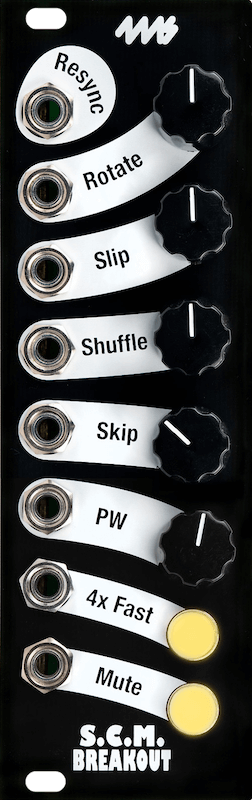
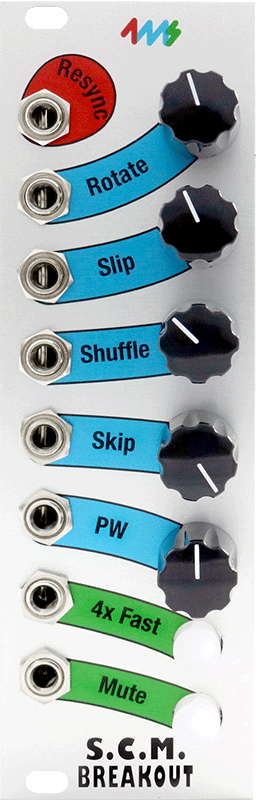
The SCM Breakout is an add-on module for the Shuffling Clock Multiplier. It adds a host of new features for controlling shuffle/swing patterns (Slip, Shuffle, and Skip), as well as Pulse Width, Mute, and 4x Fast. Each feature has a CV jack and manual knob. The Mute and 4x Fast buttons act as inverters of the gate signal on their respective jack, and light up to indicate on/off status.Features:• New features for version 2:• Mute and 4x Fast are LED buttons• Pressing Mute or 4x Fast inverts the signal on the jack• Knobs are centered straight up (12:00)DIY-Kit-Type:THT-Kit-1. This is a Do-It-Yourself kit, not an assembled module. The kit includes all parts to build the module. Only trough-hole parts to solder. Make sure to check the build guide before you buy. For build guide, more info, videos etc. please check the buttons below.
sold out at the moment
The SCM Breakout is an add-on module for the Shuffling Clock Multiplier. It adds a host of new features for controlling shuffle/swing patterns (Slip, Shuffle, and Skip), as well as Pulse Width, Mute, and 4x Fast. Each feature has a CV jack and manual knob. The Mute and 4x Fast buttons act as inverters of the gate signal on their respective jack, and light up to indicate on/off status.Features:• New features for version 2:• Mute and 4x Fast are LED buttons• Pressing Mute or 4x Fast inverts the signal on the jack• Knobs are centered straight up (12:00)DIY-Kit-Type:THT-Kit-1. This is a Do-It-Yourself kit, not an assembled module. The kit includes all parts to build the module. Only trough-hole parts to solder. Make sure to check the build guide before you buy. For build guide, more info, videos etc. please check the buttons below.

sold out at the moment
Following our ADDAC103 T-Networks this new module is also inspired by Twin T-Networks circuits used in many legendary drum machines. A simple 4 voice module with frequency controls for each of the voices. This new module also features CV inputs with attenuverters for each voice Frequency. Due to the specificities of the circuit and to keep the module at a low price these inputs are not calibrated to 1v/octave.At each voice input there’s a gate to trigger converter so any input source is possible.Audio inputs can also be used as an input, in this case and due to the nature of the gate to trigger converter, each voice can be used as very destructive filters.The top 2 channels feature a higher frequency range, the bottom 2 channels feature a lower frequency range.Features:4 voices each with:• Frequency control with CV input and attenuverter Frequency Range Switch, Low/Mod/High• Trigger Input• Audio Output• Summing Mix output with Volume controlDIY-Kit-Type:SMD-Kit-2. This is a Do-It-Yourself kit, not an assembled module. The kit includes all parts to build the module. It includes SMD and through-hole parts! For build guide, more info, videos etc. please check the buttons below.(Test)

sold out at the moment
Following our ADDAC103 T-Networks this new module is inspired by its simplicity. This is a 4 voice Square Oscillator with VCA, FM switch and a slew decay for the incoming Trigger IN. All voices are then sent through a Multimode Filter.Each voice has its own VCA input where any input is accepted (Trigger, Gate, CV). The [DECAY] controls the slew decay applied to the incoming signal, if [DECAY] is fully anti-clockwise then it works as a Mute. The [FM ON] switches activate/deactivate the FM input coming from the previous voice: Voice 1 FM comes from voice 4, voice 2 FM comes from voice 1, and so on, so you can FM all of them in a FM loop.All 4 voices are summed and sent through a filter with controls over [CUTOFF] with an Attenuverter for the CV input and [RESONANCE]. Three filter outputs are provided [LOWPASS], [BANDPASS] and [HIGHPASS]The [EXTERNAL IN] input can be routed through a jumper on the back of the module allowing the incoming signal to go to:1. the filter input for processing an external audio source;2. all of the 4 voices Frequency control allowing for some experimental CV control over pitch of all 4 voices at the same time (due to the specificities of the circuit and to keep the module at a low price these inputs are not calibrated to 1v/octave).DIY-Kit-Type:SMD-Kit-2. This is a Do-It-Yourself kit, not an assembled module. The kit includes all parts to build the module. It includes SMD and through-hole parts! For build guide, more info, videos etc. please check the buttons below.

sold out at the moment
This is the last module in our T-Networks series, a straightforward 4 voice module with frequency and decay controls for each of the voices. As the name already unveils we added a noise source and created 2 different circuits that explore the timbre of a t-network when used to filter noise.There are 2 different circuits in this module: voices 1 to 3 have a pre-vca t-network filter while in voice 4 the t-networks filter applied post-vca.At each voice input there’s a switch that sets which type of input to use; this signal will be used to control an internal VCA hence why the type of setting defined here is important:1. Trigger - Any incoming CV will be converted into a 1ms trigger as soon as it crosses its fixed threshold.2. Mute - This disconnects then incoming signal effectivelly muting the voice.3. Envelopes - This can be used with CV sources as well as Gate sources and simply follows the input signal.This incoming signal will then be processed by a slew circuit which adds a decay factor allowing the user to set the “Tail” of each voice.Trigger mode is mostly dedicated for percussive sounds while the Envelope mode is open to any external envelope control and able to control noise swooshes, swirls, crackles and pops simply out of t-networks filtered noise.Audio inputs also welcome use as a Trigger/Envelope input, in fact the results of using this method had us all extremely surprised, so please do try it out!Diferences between voices:The first 3 voices also feature a Timbre selector switch: Hat/SnareIn Snare mode all frequencies coming from the t-networks filter pass through to the output .In Hat mode it adds a High Pass circuit which removes the mid/bottom frequencies (characteristic of the snare strike) creating a higher spectrum output which is closer to a Hat timbre.All of these 3 voices are also differently tuned from each other to offer more timbrical options.Voice 4 is closer to a typical t-networks circuit but this time a peculiar one where the noise is gated by the vca and then sent through the t-networks filter.Hat and Snare are terms used very loosely here; they are timbrical references and do not in any shape or form try to effectively replicate the complex timbres of a real world Hat or Snare.Features:4 Voices each with:• Frequency control• Decay control• Timbre type, Hat/Snare (Voice 1 to 3)• Frequency Range Switch, Low/Mod/High (Voice 4) Input• Audio Output• Also and overall Summing Mix output with Volume control and 2 diferent output types (Normal/Dirt)DIY-Kit-Type:SMD-Kit-2. This is a Do-It-Yourself kit, not an assembled module. The kit includes all parts to build the module. It includes SMD and through-hole parts! For build guide, more info, videos etc. please check the buttons below.

sold out at the moment
We started this module with the idea of developing a complex drum source. However, somewhere along the process we noticed how much better it performed as a synth voice and simply embraced this lucky accident.It features a VCO with a [FREQUENCY] and [FINE TUNE] knob plus a dedicated CV Input and Attenuator knob (tunable over 4 octaves). The VCO waveform output is achieved by selecting either a Triangle or Saw through a switch. The selected waveform can then be mixed/balanced against the square wave. The resulting mix is then sent to the Filter.The Filter features a [CUTOFF] and [RESO] resonance knob plus a Cutoff CV Input and Attenuverter knob.A 3 position switch is used to select the filter type: Highpass, Bandpass or Lowpass. The resulting output is then sent to the VCA.The VCA features an Input with [INPUT GAIN] knob which at maximum can amplify the incoming signal by a factor of 2.This is a very important control, it accepts any signal Trigger, Gate or CV. Whatever input is plugged in the signal is then fed through an AD with a very short attack and controllable decay through the [VCA DECAY] knob plus the CV Input and Attenuverter knob. The resulting slewed signal is then used to control the VCA gain. This signal is also sent to the CV OUTPUT as well as the LED monitor.The Accent input adds to the Input signal creating a different amplitude output. The CV OUTPUT is normalled to the Frequency and Cutoff inputs.DIY-Kit-Type:SMD-Kit-2. This is a Do-It-Yourself kit, not an assembled module. The kit includes all parts to build the module. It includes SMD and through-hole parts! For build guide, more info, videos etc. please check the buttons below.

sold out at the moment
This small utility is the pedal lover's best friend, it allows 2 diferent chains of pedals to be independently connected to your synth.The Send channels attenuate the synth level to instrument level.The Return channels amplify the signal from instrument to synth level.DIY-Kit-Type:SMD-Kit-2. This is a Do-It-Yourself kit, not an assembled module. The kit includes all parts to build the module. It includes SMD and through-hole parts! For build guide, more info, videos etc. please check the buttons below.