
Modular

available
The CubuSynth VCFA is a multimode VCF with LP,HP and BP modes with integrated VCA, CV control over frequency, resonance and volume. The CV input for the frequency features 1V/Oct scaling over about 2~3 octaves. So you can even create plucky melodies with the resonance in "ringing" mode. The gain control can reach a nice, soft saturation.Features:• 3 simultaneous Outputs for Low Pass, Band Pass and High Pass• Integrated VCA at the input stage• CV control over volume, frequency and resonance• "Ringing" mode on upper resonance setting• 1 V/oct tracking over 2~3 octaves (with freq CV attenuator on 100%)• Saturation on incoming signal (VCA stage) on upper gain settingDIY-Kit-Type:THT-Kit-1. This is a Do-It-Yourself kit, not an assembled module. The kit includes all parts to build the module. Only trough-hole parts to solder. Make sure to check the build guide before you buy. For build guide, more info, videos etc. please check the buttons below.

available
The CubuSynth VCLFO v2 is a Digital Voltage controlled Low frequency oscillator, with 16 Waveforms, Step control (Sample & Hold style), LFO Sync / Reset, CV control over Frequency, Amplitude, Waveform, Frequency multiplier, Skew and Step Rate.It is based on the Electric Druid VCLFO10 chip which was written/designed by Tom Wiltshire aka "Electric Druid".Features:• 16 Waveforms selectable in two Banks of 8• Frequency range: 0.05Hz to 12.8Hz (102.4Hz with multiplier x8)• 6 CV inputs for Multiplier, Frequency, Step Rate, Skew, Waveform and Level• "Sync" Input for LFO reset, or Step Sync• 3 outputs: Uni-Polar (0 to +5V), Bi-Polar inverted (+5V to -5V / 10Vpp) and Bi-Polar normal (-5V to +5V / 10Vpp)DIY-Kit-Type:SMD-Kit-1. This is a Do-It-Yourself kit, not an assembled module. The kit includes all parts to build the module. All SMD parts are pre-soldered, only trough-hole parts to solder. For build guide, more info, videos etc. please check the buttons below.

available
Gloop is a Eurorack performance looper designed for layered loop manipulation, granular-style textures and hands-on live control. It records audio into a continuous buffer of up to two minutes and plays it back using four simultaneous playheads, each with independent speed, pitch, direction, volume and loop position.Each playhead can scan a different part of the recorded loop or focus on its own sub-loop, making it easy to create dense textures, shifting drones, rhythmic variations and evolving sound beds from a single recording. Four assignable CV inputs allow external modulation of playhead speed, position or volume, and the built-in delay, reverb and bitcrush effects add further sound-shaping options.The two mono outputs allow each playhead to be routed individually or sent to both outputs, supporting flexible effects routing and stereo movement when used with a panning mixer. Grid mode slices the loop into 4, 8 or 16 quantized regions, keeping playback positions and loop sizes locked to rhythmic divisions for precise beat-based performance.Designed for live use, Gloop includes dedicated physical volume controls for each playhead, plus record and overdub control via the front-panel button or trigger input. Compact, immediate and highly flexible, Gloop turns recorded audio into a playable modular instrument for loop mangling, texture building and experimental sampling.• Eurorack performance looper with four simultaneous playheads.• Up to two minutes of continuous 48kHz / 24-bit audio recording.• Independent speed, pitch, direction, volume and position per playhead.• Sub-loop control for layered textures and granular-style playback.• Four assignable CV inputs for speed, position or volume modulation.• Built-in delay, reverb and bitcrush effects.• Two mono outputs with flexible playhead routing.• Grid mode with 4, 8 or 16 quantized loop regions.• Record and overdub via button or trigger input.DIY-Kit-Type:SMD-Kit-1. This is a Do-It-Yourself kit, not an assembled module. The kit includes all parts to build the module. All SMD parts are pre-soldered, only trough-hole parts to solder. For build guide, more info, videos etc. please check the buttons below.

only 2 left
The Cali oscillator is a new and improved version of the classic Buchla 258 wave shaping oscillator with an additional pulse width modulated output.The oscillator features the classic Sine to Square and Sine to Saw wave shaping with dedicated CV control.The Cali Oscillator differs from previous versions of the 258 in that it has a 3-way position switch rather than 2-way.This new middle position features a bonus waveform that will shape from a pulse into a kind of triangular trapezoid shape.The shaping control is more unpredictable in this middle position and the switch reacts to body contact when the wave shape is set low – it can bethought of as an extra bonus waveform, great for producing glitchy sounds! There are dedicated inputs for linear and logarithmic FM and the Cali alsoadds a Pulse output with it’s own width control and PWM CV input.The behaviour of the pulse output can be affected by the position of the waveform switch and wave shape control.The module features Coarse and Fine frequency controls and an LFO mode, LFO range is accessed via an LED pushbutton that alsoacts as the LFO speed indicator – the button will light up when the waveform moves through its positive cycle.Because the wave shape modulation is independent of pitch this oscillator is very useful for creating complex timbres whilst retaining musical pitch.Features:• Sine to Saw/Square Waveform Output with CV over wave shaping• Pulse output with voltage controlled PWM• Linear FM with attenuator• Logarithmic FM with attenuator• Bonus ‘trapezoid’ output• Coarse & Fine controls with LFO mode• Includes power supply isolation on frequency controlsDIY-Kit-Type:THT-Kit-1. This is a Do-It-Yourself kit, not an assembled module. The kit includes all parts to build the module. Only trough-hole parts to solder. Make sure to check the build guide before you buy. For build guide, more info, videos etc. please check the buttons below.

only -1 left
The Dannysound Dynamics is a compressor / expander originally designed to process drums but like most processing devices, it can be used for a wide variety of applications.The module comprises of:• Compressor / Expander• Sub Bass Enhancer• 3 Band Inductor-based EQ• Harmonic ExciterThe compressor / expander section uses a discrete transistor-based circuit that allows for soft clipping when overdriven.The envelope detector is known as a feedforward type of circuit; taking it’s input from the signal before it goes to the compressor rather than after.This type of circuit is known for having fast attack times.The Sub Bass enhancer has its own compression circuit that “ducks” the initial transient. This allows the sub bass to be increased without distortionon the transient peaks increasing the overall level.There is a MIX control to allow the unprocessed signal to be mixed back in with the processed signal.The 3 band EQ is an inductor based LCR design. After trying out various EQ topologies this was the design that sounded the nicest.When overdriven it gives a nice “bite” to the sound and it has a certain characterful charm that’s hard to put into words.The controls have a response that are subtle to begin with and get more pronounced as the controls are increased.The Harmonic Exciter adds a little distortion to the high frequencies which bring out the sparkle of cymbals or the snap snare drums.The operating bandwidth can be switched between Low (snare drum snap) or High (Cymbals sparkle).There are inputs for side chaining and control with an external envelope as well as an envelope out to make the envelope detector output available to drive other modules.It also features separate inputs and outputs for the Compressor / Expander and EQ sections, so they could be used as 2 separate modules.Features:• Compressor / Expander• Sub Bass Enhancer• 3 Band Inductor-based EQ• Harmonic Exciter• Envelope In/Out• Sidechain Input• Separate In/Out for Comp/Exp and EQ sectionsDIY-Kit-Type:THT-Kit-1. This is a Do-It-Yourself kit, not an assembled module. The kit includes all parts to build the module. Only trough-hole parts to solder. Make sure to check the build guide before you buy. For build guide, more info, videos etc. please check the buttons below.

available
The EN129 Thru Zero Oscillator is an all analogue triangle-core VCO specialising in frequency modulation.Analogue through-zero FM modulation produces a wide array of timbres particularly useful for bell like or percussive sounds.Through zero linear frequency modulation can be precisely dialled in thanks to a dedicated CV input attenuator and through zero offset control.Logarithmic FM is also available via it’s own dedicated input with attenuator and both FM inputs have an LED to indicate incoming voltages.Simultaneous analogue wave outputs include: Sine, Triangle, Sawtooth, Square and Pulse wave with Pulse Width Modulation.The PWM control goes to zero at either end of it’s range, which is very useful for creating rhythmic sounds with voltage control.Furthermore the PWM control doubles up as wave shape modulation for the Sawtooth wave – gradually altering the waveform until it shifts half a cycle.The EN129 features Coarse and Fine frequency controls as well as an LFO mode. LFO range is accessed via an LED pushbutton that alsoacts as the LFO speed indicator – the button will light up when the waveform moves through its positive cycle.A new addition of a Soft Sync Input allows the phase of the oscillator to be controlled by an external oscillator for an even greater range of timbres.Features:• Soft Sync Input• Thru Zero linear FM• Logarithmic FM• Zero to zero pulse width modulation• Sawtooth wave shape modulation• Simultaneous outputs for: Sine, Triangle, Saw, Pulse & Square• Coarse & Fine controls with LFO mode• Includes power supply isolation on frequency controlsDIY-Kit-Type:THT-Kit-1. This is a Do-It-Yourself kit, not an assembled module. The kit includes all parts to build the module. Only trough-hole parts to solder. Make sure to check the build guide before you buy. For build guide, more info, videos etc. please check the buttons below.

sold out at the moment
The LOOPING VCADSR is a 4-stage envelope generator that uses a Microcontroller from Electric Druid to generate a Voltage Controllable,Loop-able Envelope. The individual parts of the Envelope (Attack, Decay, Sustain, Release and Level) can all be individually controlled via CV.This module has 3 MODES of operation:• Normal Envelope – Gate signal fires ADSR• Gated Looping Envelope – ADSR loops whilst gate signal is high.• Looping Envelope – ADSR loops regardless of gate signal.When the envelope is looping, all 5 controls affect the output. Attack and Decay operate, as one would expect.The Sustain control sets the minimum voltage the decay part of the envelope will decay to.The Release sets a release time from the end of the Sustain period to the beginning of the next cycle.When the Sustain is set to 0 you can use the Release control to add a delay between the Attack and Decay cycles.In Normal Envelope mode the Sustain CV input can be used with an LFO source to add amplitude modulation that gradually increasesas the Envelope transitions from the Attack/Decay part of the envelope into the Sustain part.The Level CV is also a useful point for amplitude modulation or can be used for Velocity Sensitivity via CV.Features:• 3 Modes of operation: Normal, Gated Loop, Constant Loop• CV over: Attack, Decay, Sustain, Release, Level• Works with GATE signals from +5V to +12V• Output CV range 0V to +10V• Based on the ENVGEN circuit design from Electric DruidDIY-Kit-Type:THT-Kit-1. This is a Do-It-Yourself kit, not an assembled module. The kit includes all parts to build the module. Only trough-hole parts to solder. Make sure to check the build guide before you buy. For build guide, more info, videos etc. please check the buttons below.

only 1 left
The M.M. VCA is a 6HP Eurorack VCA module based on the classic design by Dr. Robert Moog as used in his first portable synthesiser.The discreet design of the circuit has inherent soft clipping characteristics when driven, which either add harmonics to a pure sine wave orconversely remove higher order harmonics when amplifying waves such as a Saw or Triangle.This has the effect of slightly boosting the fundamental frequency, making sounds that are fatter and warmer than standard VCAs.The M.M. VCA has two inputs with level controls – both inputs are then routed through two VCAs in series (PRE-AMP and MAIN AMP).This allows for modulation of the first VCA (PRE-AMP) with an LFO and the second (MAIN AMP) with an Envelope Generator.An offset control provides a DC control voltage to the first VCA that can be used to bias the modulation so it doesn’t cut offWhen the LFO is in the negative part of its cycle. This control should be set to full if modulation of the first VCA is not being utilised.Features:• 2 x Audio Input Level Controls – Starts soft clipping after approximately 50%.• CV 1 (PRE-AMP) Level – Adjusts the amount of CV to VCA 1.• CV 2 (MAIN AMP) Level – Adjusts the amount of CV to VCA 2 (Normalled to 10V).• CV 1 OFFSET Amount – Adjusts the amount of DC bias control voltage to VCA 1.DIY-Kit-Type:THT-Kit-1. This is a Do-It-Yourself kit, not an assembled module. The kit includes all parts to build the module. Only trough-hole parts to solder. Make sure to check the build guide before you buy. For build guide, more info, videos etc. please check the buttons below.

sold out at the moment
The Multi-Mode Ladder (MML) Filter is a twist on the classic transistor ladder low pass filter by Dr. Robert A. Moog.This filter updates the classic 4-pole ladder design to provide Band Pass and High Pass filter responses as well as the traditional Low Pass filter,this module also adds CV control over the resonance as well as two frequency CV inputs.The circuit features a fully discrete transistor design with an op-amp buffered output, this allows soft saturation of the input signalto get the classic overdriven tones of the ladder filter. A bass compensation circuit has been included to retain the bass response in Low Pass modewhen the resonance is increased.The bass compensation also helps to improve the response of the High Pass filter.The bass compensation can be removed if the user wishes to have a more classic response (see mods section in build doc).Features:• Low Pass, Band Pass and High Pass modes.• CV controlled resonance.• Added low frequency compensation.• Soft saturation of input.• 2 x frequency CV inputs.DIY-Kit-Type:THT-Kit-1. This is a Do-It-Yourself kit, not an assembled module. The kit includes all parts to build the module. Only trough-hole parts to solder. Make sure to check the build guide before you buy. For build guide, more info, videos etc. please check the buttons below.

sold out at the moment
The Timbre is a 6HP Eurorack module based on the wave folder section of the Buchla 259 oscillator as implemented in the Music Easel.The wave folder adds extra harmonics to input signals that have low harmonic content to creating rich and interesting timbres.Typical input sources to use would be Sine and Triangle waves but you are welcome to try other sources as well!The Dannysound Timbre adds an extra input to the Buchla design to allow 2 oscillators to drive the wave-folder simultaneously –this dramatically increases the range of possible tones that can be generated and allows the folder to go wild!Buchla 259 inspired waveshaper, the perfect module to put in-between your Dannysound Cali and EN129 oscillators!Features:• Osc1 / Osc2 Mix – Adjusts mix between oscillator 1 and 2 inputs, also acts as an attenuator if only one of the inputs is used.• Timbre Control – Adjusts the overall wave fold amount.• Timbre CV – Bipolar (attenuverter) controls the Timbre CV input.• Symmetry – Adds an offset to the input so the top half of the wave starts folding earlier.• Blend – Mixes between the clean and effected sound.DIY-Kit-Type:THT-Kit-1. This is a Do-It-Yourself kit, not an assembled module. The kit includes all parts to build the module. Only trough-hole parts to solder. Make sure to check the build guide before you buy. For build guide, more info, videos etc. please check the buttons below.

only 1 left
The Dannysound VU Meters is designed to be used with 2 x Dynamics modules. The modules connect internally via 2x3 pin ribbon cables.The meters provide a visual representation of various signals within the Dynamics modules making settings easier.Controls For Each Channel:3 position toggle switch:1. C/E OUT – Monitor compressor/expander output.2. INPUT – Monitor Dynamics input level or external input if it’s used.3. C/E AMT – Monitor Dynamics compression/expansion amount.3 position toggle switch:1. HI SENS – High sensitivity setting, best for monitoring the C/E OUT signal of percussive sounds and drums etc.2. OFF – If you want to turn meters off. Note that this stops the needles moving but the backlights will stay on.3. LO SENS – Low sensitivity setting, best for monitoring the C/E AMT signal or anything that overloads the HI SENS setting.Features:• External input sockets for monitoring external sources.• Switch to select high or low meter sensitivity or off if the clicking needles get annoying!• Monitoring of the compression/expansion amount.• Monitoring of the unprocessed input level.• Monitoring of the compressor/expander output level.DIY-Kit-Type:THT-Kit-1. This is a Do-It-Yourself kit, not an assembled module. The kit includes all parts to build the module. Only trough-hole parts to solder. Make sure to check the build guide before you buy. For build guide, more info, videos etc. please check the buttons below.

only 2 left
This module is based around a BBD integrated circuit and allows for classic delay-based effects, from slapback echoes to trailing reverberations, from flanger-like sounds to crusty down-sampled madness.The module is DIY, sold as a kit by Erica Synths and comes with a very thorough assembly manual that provides deep insight into the functioning of every part of the circuit you'll build.The module itself features all your classic delay-related controls, from delay time to feedback amount, a dry/wet mix control and even a switch to select between 2 different delay ranges.A nice, surprising addition is a patch point labeled "Inhibit CV" which, whenever it is presented with a gate signal, will disconnect the clock signal from the BBD chip, essentially stopping the effect in its tracks. The clock will resume as soon as the gate goes low at this patch point, and the BBD circuit will then return to normal operation. This feature lets the player add some rhythm to the effect or perform other interesting shenanigans.We - Erica Synths and Moritz Klein - have developed a series of educational DIY kits under the brand name mki x es.EDU with one specific goal in mind: to teach people with little-to-no prior experience how to design analog synthesizer circuits from scratch. What you’ll find in the box is not simply meant to be soldered together and then disappear in your rack. Instead, we want to take you through the circuit design process step by step, explaining every choice we’ve made and how it impacts the finished module.NB! All kits in these series are simple and come with extensive user manuals which can be downloaded separately, therefore we will not provide customer support in case your DIY build fails to function or similar.DIY-Kit-Type:THT-Kit-1. This is a Do-It-Yourself kit, not an assembled module. The kit includes all parts to build the module. Only trough-hole parts to solder. Make sure to check the build guide before you buy. For build guide, more info, videos etc. please check the buttons below.

only 2 left
Need some professional polish in your modular system? With this simple diode-based compressor, you can shape the dynamics of your sound, adding punch and consistency to your patches. Whether you’re looking to beef up your basslines, add sustain to your leads, or tame the peaks of your percussion, this circuit’s got you covered.Erica Synths and Moritz Klein - have developed a series of educational DIY kits under the brand name mki x es.EDU with one specific goal in mind: to teach people with little-to-no prior experience how to design analog synthesizer circuits from scratch. What you’ll find in the box is not simply meant to be soldered together and then disappear in your rack. Instead, we want to take you through the circuit design process step by step, explaining every choice we’ve made and how it impacts the finished module.NB! All kits in these series are simple and come with extensive user manuals which can be downloaded separately, therefore we will not provide customer support in case your DIY build fails to function or similar.DIY-Kit-Type:THT-Kit-1. This is a Do-It-Yourself kit, not an assembled module. The kit includes all parts to build the module. Only trough-hole parts to solder. Make sure to check the build guide before you buy. For build guide, more info, videos etc. please check the buttons below.

available
EDU DIY Output Mixer 2 is an intermediate-level learning kit from the mki x es.EDU Drums System, created by Erica Synths and Moritz Klein. It teaches you how to build and understand a 4-channel Eurorack output mixer from scratch, starting on a breadboard and ending as a fully functional Eurorack module using the included PCB and panel.The circuit covers essential analog audio building blocks, including an inverting op-amp summing mixer, per-channel volume controls, a send/return loop, diode soft-clipping distortion and a headphone driver. The detailed illustrated manual explains each stage with clear diagrams and analogies, making the kit a practical way to learn how mixers, distortion circuits and headphone outputs work.Once assembled, EDU DIY Output Mixer 2 provides four input channels with individual level controls, per-channel sends, a return control, a variable distortion insert effect, plus line and headphone outputs. It is designed as a hands-on educational project for builders with basic electronics knowledge and previous DIY experience.All small components for the breadboard build are included, together with the Eurorack PCB, panel, power cable and a 40+ page digital manual. A breadboard, jumpers and a dual power supply are required separately. For a smoother learning experience, the kit can also be used with Labor, Erica Synths’ dedicated prototyping platform for EDU DIY learning kits.Features• Part of the mki x es.EDU Drums System by Erica Synths and Moritz Klein.• Breadboard learning build plus final Eurorack PCB and panel.• Four input channels with individual volume controls.• Send/return loop with per-channel send and return control.• Variable diode soft-clipping distortion.• Line output and headphone output.• Teaches op-amp summing, mixing, distortion and headphone driver design.DIY-Kit-TypeTHT-Kit-1. This is a Do-It-Yourself kit, not an assembled module. The kit includes all parts to build the module. Only trough-hole parts to solder. Make sure to check the build guide before you buy. For build guide, more info, videos etc. please check the buttons below.
available
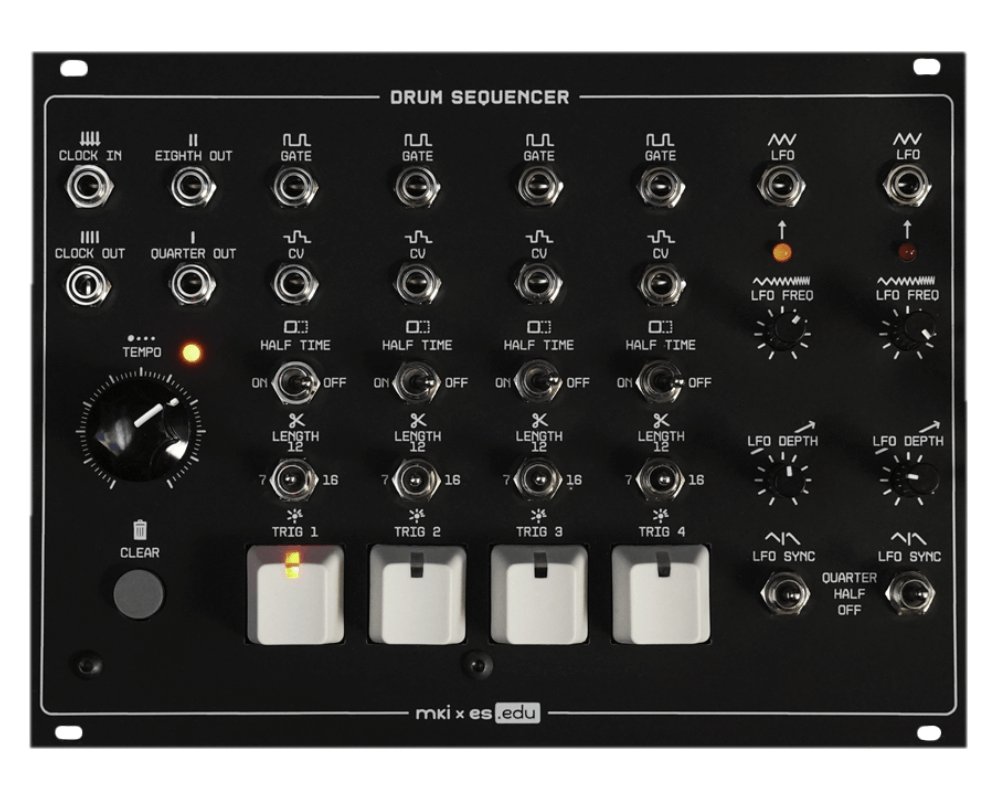
Most drum sequencers are complex machines crowded with buttons and LEDs. The mki x es.edu DIY Drum Sequencer kit takes a different path: a hands-on rhythm engine with a minimalist interface built from just a handful of logic chips. The four independent channels are programmed in real time using a single button, so patterns loop automatically, can be shortened on the fly and support half-time playback for slower, evolving grooves.Accents and dynamics are handled by synced LFOs, and a simple resistor DAC converts patterns into stepped control voltages – perfect for modulating pitch, decay, filter cutoff, or other parameters. This logic-chip sequencer delivers tactile, musical performance without relying on microcontrollers, making it an excellent DIY drum sequencer kit for learning sequencer design and sharpening soldering skills.Features:• 4 independent channels with one-button step input/removal• 16 steps per channel, individually reducible to 12 or 7• Optional half-time mode per channel• Two syncable analog LFOs for dynamic accents• Resistor-DAC output for pitch or decay modulation• Internal clock with 16th, 8th, and quarter note outputs, syncable to external gearDIY-Kit-Type:THT-Kit-1. This is a Do-It-Yourself kit, not an assembled module. The kit includes all parts to build the module. Only trough-hole parts to solder. Make sure to check the build guide before you buy. For build guide, more info, videos etc. please check the buttons below.

available
This is an easy to build Envelope Generator with a really extensive documentation and explanation of the circuit. Excellent learning kit!Many iconic sounds like the squelchy acid bass line, snappy techno kick drum, and swelling dream pop pad wouldn’t be possible if it weren’t for envelope generators. So, the next module in the mki x es.edu line is a slightly optimized ADSR envelope generator. Optimized because it has only 3 controls. With sustain on, it outputs an ASR (attack/sustain/release) envelope, but when the sustain is set to a minimum, it becomes an AD (attack/decay) envelope generator that ignores gate length; Release and Decay are controlled by the same knob. A looping function and an inverted output make the module more versatile for complex patches. The full EDU DIY system is designed to have 2 EG modules, therefore everyone aiming to build the whole system will need 2 kits.DIY-Kit-Type:THT-Kit-1. This is a Do-It-Yourself kit, not an assembled module. The kit includes all parts to build the module. Only trough-hole parts to solder. Make sure to check the build guide before you buy. For build guide, more info, videos etc. please check the buttons below.

only 2 left
This DIY module brings FM percussion to your Eurorack system, combining the raw power of analog circuits with the sharp, metallic tones of FM synthesis. From punchy kicks and deep toms to clangy, metallic hits, the mki x es.EDU FM Drum covers a wide range of percussive textures.Developed by Erica Synths and Moritz Klein as part of the educational mki x es.EDU series, this kit is designed not just for building, but for learning. It’s aimed at beginners and curious makers who want to understand analog synth design from the ground up.More than just a soldering project, this kit walks you through the full design process, explaining how each part of the circuit works and how sound is shaped, step by step.Features:• DIY FM drum voice – from kicks and toms to metallic clangs• Combines analog synthesis with FM-style sound shaping• Educational kit designed for beginners and learners• Part of the mki x es.EDU series by Erica Synths & Moritz Klein• Detailed build guide with circuit design explanations included• Inspires hands-on learning and deeper understanding of analog soundDIY-Kit-Type:THT-Kit-1. This is a Do-It-Yourself kit, not an assembled module. The kit includes all parts to build the module. Only trough-hole parts to solder. Make sure to check the build guide before you buy. For build guide, more info, videos etc. please check the buttons below.
only 2 left
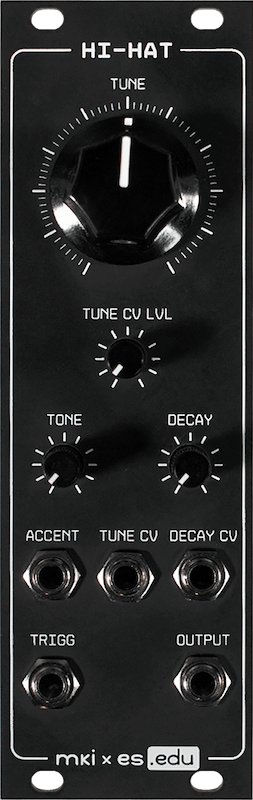
Synthesized, analog Hi-Hats are pretty fascinating. That’s because emulating any kind of cymbal using an analog circuit is tough since the sound a real cymbal produces is not quite pure noise, but also not really harmonic. Still, a couple of classic drum machines like the Roland TR-606 and TR-808 took their best shot at it, with quite strange-sounding results that have since become iconic in electronic music. Inspired by this, we decided to follow suit and continue our percussion-focused second season of educational DIY kits with the mki x es.edu DIY Hi-Hats.FeaturesFeatures:• TR-808 inspired circuit• Manual Tune, Decay and Tone controls• CV controlled Tune and Decay (-5V to +5V)• Accent input (>+2,5V)We – Erica Synths and Moritz Klein – have developed a series of educational DIY kits under the brand name mki x es.EDU with one specific goal in mind: to teach people with little-to-no prior experience how to design analog synthesizer circuits from scratch. What you’ll find in the box is not simply meant to be soldered together and then disappear in your rack. Instead, we want to take you through the circuit design process step by step, explaining every choice we’ve made and how it impacts the finished module.NB! All kits in these series are simple and come with extensive user manuals that can be downloaded separately, therefore we will not provide customer support in case your DIY build fails to function or similar.DIY-Kit-Type:THT-Kit-1. This is a Do-It-Yourself kit, not an assembled module. The kit includes all parts to build the module. Only trough-hole parts to solder. Make sure to check the build guide before you buy. For build guide, more info, videos etc. please check the buttons below.

sold out at the moment
This is the Full Kit with a wide assortment of essential components (resistors, capacitors, ICs, transistors) so you can start building right away.Get started in circuit design with MKI x ES Labor. Developed in collaboration with Dr. Shalom D. Ruben teaching professor for engineering at the University of Colorado Labor is a fully-featured circuit design playground and a powerful electronics learning tool all in one. Created with the aim of serving as a universal learning tool for electronics engineering Labor enables users to delve into various aspects of electronics design from fundamental concepts to advanced techniques. Whether you're a beginner exploring the basics or an experienced engineer honing your skills Labor provides a versatile platform for experimentation and learning. Create your own filters oscillators envelopes sequencers – and whatever else you can come up with. Or use it to learn the basics by following along with our series of educational DIY kits.Features:• a built in dual power supply producing eurorack-compatible voltages, with built-in over current protection for safe experimenting• a modular interfacing section with 16 slots for potentiometers, jacks & switches• a pulse/triangle/sine oscillator (audio & LFO range)• a multi mode envelope generator controlled by a premium push button• a buffered variable control voltage source• an output amplifier with variable gain• a dedicated headphone output and a line-level output for recording, processing and analyzing the signal• an expansion slot for installing specialized prototyping tools• a protective lid to cover a breadboard.EDU DIY Labor Full Kit includes:• LABOR• Power Supply Unit• jumper cables• array of interfacing elements like potentiometers, jack sockets, switches• commonly used components (resistors, capacitors, chips, transistors) to start building circuits straight awayNB! LABOR is a testing ground for experiments with electronic circuits and we as a manufacturer cannot by any means diagnose any issues with circuits designed on the LABOR board. We will only respond to support tickets regarding obvious malfunctions of the factory-soldered circuits on the main LABOR board. For other cases of malfunction – please consult other LABOR users/ experienced DIY kit builders on online forums, such as this one. Keep experimenting – keep trying!DIY-Kit-Type:SMD-Kit-1. This is a Do-It-Yourself kit, not an assembled module. The kit includes all parts to build the module. All SMD parts are pre-soldered, only trough-hole parts to solder. For build guide, more info, videos etc. please check the buttons below.

available
This PSU connector makes it easy to supply power to your Eurorack modules within the DIY.EDU Labor environment. It provides a simple interface for connecting modules to the Labor’s internal power distribution.Features:• Power connector for integrating Eurorack modules into the Labor• Compatible with the DIY.EDU Labor workspace• Simplifies prototyping and testing of powered modules• Compact and easy to installDIY-Kit-Type:THT-Kit-1. This is a Do-It-Yourself kit, not an assembled module. The kit includes all parts to build the module. Only trough-hole parts to solder. Make sure to check the build guide before you buy. For build guide, more info, videos etc. please check the buttons below.