
Envelope & Modulation

available
Infinitely Maybe is a full featured randomness module, with a number of sources of randomness:• White noise• Pink noise• Sample and hold circuit• Random gates circuitAn onboard CV mixer allows you to mix two different sources into the sample and hold circuit. White noise is normalised to CV input 1, Pink noise is normalised to CV input 2Infinitely Maybe has an onboard clock for triggering the sample and hold circuit. This may be overridden with an external clock if required via the clock in socket.There is a built in LAG circuit, which enables the S/H OUT to slide between voltages at a predetermined rate. This function can be remotely controlled via the LAG INFinally, a random gates output is derived from the S/H Out. With the MAYBE knob at 0 a constant gate is available. The further you turn the MAYBE knob towards 10, the less likelihood of a gate is.DIY-Kit-Type:THT-Kit-1. This is a Do-It-Yourself kit, not an assembled module. The kit includes all parts to build the module. Only trough-hole parts to solder. Make sure to check the build guide before you buy. For build guide, more info, videos etc. please check the buttons below.

sold out at the moment
Full featured, fully modular synthesiser for Eurorack with a pre-patched normalised signal path for quick setup.A combination of the XVCO TWO, Raging Bull 3.0 VCF/VCA, and System X Envelope, where each section can be used completely individually or as part of the larger whole.Onboard LFO for PWM and FM and Noise Source.DIY-Kit-Type:THT-Kit-1. This is a Do-It-Yourself kit, not an assembled module. The kit includes all parts to build the module. Only trough-hole parts to solder. Make sure to check the build guide before you buy. For build guide, more info, videos etc. please check the buttons below.

available
Shapes is a wide ranging and fully analogue oscillator which can perform duties as both auxilliary VCO* as well as VC-LFO. Shapes can be configured to cycle continuously, or to provide one-shot shaped outputs. When set to one-shot mode, Shapes may be used as an ersatz envelope generator.Using the Time knob, Shapes can cycle from as low as 8 seconds (whale song) to as high as 19500Hz (bat beeps).Shapes has 3 simultaneous outputs:sawtooth (+/-5V, 10Vpp)ramp (+/-5V, 10Vpp)triangle (+/-5V, 10Vpp)Additional waveforms may be derived courtesy of the Shape knob. Anticlockwise from 0 achieves progressively logarithmic sawtooths and ramps, whereas clockwise from 0 achieves progressively exponential sawtooths and ramps. The effect of the Shape knob on the triangle waveform is asymmetric, anticlockwise from 0 achieves progressively logarithmic leading edge, whereas clockwise from 0 achieves progressively exponential falling edge. Progressively exponential triangle waveforms can be achieved using the Time CV knob (set Shape knob to 0) providing there is no jack in the Time CV input socketTime CV input provides wide ranging control of time. It is possible to dial in something approaching 1V/oct over a limited range, although Shapes has not been designed to perform as an accurately tracking VCO. In the audio range, Shapes comes into it’s own when used as a ‘daughter’ VCO to an external ‘mother’ VCO by patching the ‘mother’ VCO into Shapes’ Gate In input socket – some impressive oscillator sync style effects can be achieved.Gate In can also be used to initiate waveforms in one-shot mode, where a pulse of any length will cause Shapes to complete one cycle.*Shapes has not been designed to perform as an accurately tracking audio VCO.DIY-Kit-Type:THT-Kit-1. This is a Do-It-Yourself kit, not an assembled module. The kit includes all parts to build the module. Only trough-hole parts to solder. Make sure to check the build guide before you buy. For build guide, more info, videos etc. please check the buttons below.

sold out at the moment
Envelope Generator, based on the Roland System 100M 140 ADSR. “The snappiest ADSR in the world”.DIY-Kit-Type:THT-Kit-1. This is a Do-It-Yourself kit, not an assembled module. The kit includes all parts to build the module. Only trough-hole parts to solder. Make sure to check the build guide before you buy. For build guide, more info, videos etc. please check the buttons below.

sold out at the moment
Fixed voltage sources are not a new idea in modular, but we hope that Turn! Turn! brings a new twist to the concept. Turn! Turn! features two independent fixed voltage sources with a useful range of features.Turn! Turn! grew out of a conversation with Steve Levine – when a producer of such note makes a suggestion you have to listen – and act on it. Steve suggested that it would be useful to have a fixed voltage source under the control of a big knob, and the ability to go from as little as 1V over the entire range of the knob. Hence subtle, incremental changes are possible.The final feature set includes a voltage selection switch as well as a unipolar/bipolar switch. Both normal and inverted outputs are included. The following ranges are available from Turn! Turn! depending on switch positions:• 0V to 1V• 0V to 2.5V• 0V to 5V• -1V to 1V• -2.5V to 2.5V• -5V to 5VDIY-Kit-Type:THT-Kit-1. This is a Do-It-Yourself kit, not an assembled module. The kit includes all parts to build the module. Only trough-hole parts to solder. Make sure to check the build guide before you buy. For build guide, more info, videos etc. please check the buttons below.

available
Ultra Wave is a fully expanded version of the Wave Runner LFO. It’s a multi-waveform sync-able LFO based on the Electric Druid TAPLFO2D family of code, but with some significant additions and improvements. The WAVERUNNER 1 PIC and code is exclusive to Frequency Central and was developed specifically for the Wave Runner/Ultra Wave, and is not compatible with similar modules.Ultra Wave has both manual and CV control of frequency, clock multiple, waveform and wave distortion. Additionally there’s sync input and output level CV input. Two outputs, LFO and clock.DIY-Kit-Type:THT-Kit-1. This is a Do-It-Yourself kit, not an assembled module. The kit includes all parts to build the module. Only trough-hole parts to solder. Make sure to check the build guide before you buy. For build guide, more info, videos etc. please check the buttons below.

sold out at the moment
Wave Runner is a multi-waveform sync-able LFO based on the Electric Druid TAPLFO2D family of code, but with some significant additions and improvements. The TAPLFO2D-FC PIC and code is exclusive to Frequency Central and was developed specifically for the Wave Runner, and is not compatible with similar modules.All waveforms can be skewed using the Distort knob, as well as control over pulse width of square, and distortion of the cyclic waveforms, this get you control over Noise freq as well as bitcrushing, bitcrush of S/H down to 1 bit for random triggers. Tap sync input, for syncing to whatever. Wave Runner measures the last two incoming pulses and syncs itself to these. Multiply knob allows for Wave Runner to run at x0.5, x1, x1.5, x2, x3 and x4 of the incoming sync pulse. Freq is from stupid slow (0.025Hz) into low audio range (50Hz). The latest version also features Level CV input to control the absolute output level of the LFO.Features:8 Waveforms available• sawtooth• ramp• pulse• triangle• sine• noise• sample and hold• stepped triangle / sawtooth / rampDIY-Kit-Type:THT-Kit-1. This is a Do-It-Yourself kit, not an assembled module. The kit includes all parts to build the module. Only trough-hole parts to solder. Make sure to check the build guide before you buy. For build guide, more info, videos etc. please check the buttons below.

sold out at the moment
This is the DIY version of this unit.Pathways is a modular matrix mixer designed for feedback manipulation, creative routing, weird synthesis… and many other things.Based around sixteen analog VCAs it can be the central hub of many different setups and a bridge between desktop gear and eurorack systems.Features:• 4x 1/4″ inputs with gain / drive control, 4x 1/4″ outputs• Each of the 16 matrix intersections can be controlled manually or via CV, a dedicated LED gives visual feedback of the channel volume• An envelope follower is normalled to input four, the signal then gets fed through a clock divider with three cascaded outputs. Willingly, an external signal can be inserted into the divider• Two voltage controlled LFOs can modulate any parameter and create dynamic feedbacks, asymmetrical panning, tempo-related fx send/returns• If patched into itself, each channel can self oscillate so it can be used as a polyphonic cv-controllable drone synthesizer• full eurorack compatibility, each parameter has its own 1/8″ input jackDIY-Kit-Type:SMD-Kit-1. This is a Do-It-Yourself kit, not an assembled unit. The kit includes all parts to build the unit. All SMD parts are pre-soldered, only trough-hole parts to solder. For build guide, more info, videos etc. please check the buttons below.

sold out at the moment
This is the DIY version of this unit.Solid Felt is a stereo multimode analog filter in desktop format.Its name comes from the etymology of the words “stereo” and “filter”.From subtle timbral variation to an all-encompassing sonic treatment, Solid Felt can be used in multiple ways to embellish or vandalize your sound bouquet:As two independent mono filtersto give a stereo treatment to a mono signalto filter a stereo signal at the same cutoff frequency on the L and R channelsAs a mono 24dB/oct filter (placing the two filters in series)To synthesize sounds, via external feedback patchingTo extrapolate a CV signal from your audio input and use it to control any of its parameter or external gearAs a stereo overdrive effectTo bring line level signals to Eurorack levelFeatures:• 2x Analog multimode analog filters• 2x 1/4″ jack high impedance inputs• 2x 1/4″ jack low impedance outputs• 8x 1/8″ jack eurorack compatible CV inputs• 8x 1/8″ jack eurorack compatible CV outputs• Input gain control to amplify incoming signals up to fuzzy territory• mode control to select between lowpass, bandpass and highpass filter response (CV controllable)• an envelope follower (normalled to input A) which is fed into a three stage clock divider• a voltage controlled LFO with waveform blend control and two outputs 180° out of phase• a voltage controlled LFO with rising and falling sawtooth outputsDIY-Kit-Type:SMD-Kit-1. This is a Do-It-Yourself kit, not an assembled unit. The kit includes all parts to build the unit. All SMD parts are pre-soldered, only trough-hole parts to solder. For build guide, more info, videos etc. please check the buttons below.

only 2 left
ASCOLTA is a dual high fidelity input preamp with envelope follower and peak detector output for each channel. Ascolta consist of two individual high quality preamp connected to an envelope follower and a peak detector output. On the back of the module you can select the behaviour of its internal normalization when no cable is plugged into I2:S: the first input I1 will accept stereo 3.5mm standard cables from any source and split L and R to output O1 and O2 respectively. This way you can directly amplify stereo signals without the need of external splitters and regulate the gain of each channel individually.G: the second amplifier will double the amplification of the first totalling a gain range of 80dB - 10.000x.Envelope E and peak P outputs are strictly related to the gain level of their corresponding amplifier and will follow the dynamic of any input plugged.Features:• Two high quality 40 dB amplifiers.• Customizable internal normalization.• Envelope and Peak output following the input signal• Audio graded potentiometers.• “Whatever” power connector a.k.a. don’t mind the polarity.DIY-Kit-Type:SMD-Kit-1. This is a Do-It-Yourself kit, not an assembled module. The kit includes all parts to build the module. All SMD parts are pre-soldered, only trough-hole parts to solder. For build guide, more info, videos etc. please check the buttons below.

only 2 left
GITGUD is a pack of 9 individual LFOs - 5 squares and 4 triangle waves.The frequency is set with analog touch controls; they act like potentiometers and they keep the value once the finger is lifted from the surface.As it takes time to turn a pot, it takes time to interact with these controls:bridge with your finger the first line and the center to decrease the frequency or the center and the last one to increment. A red and a blue LEDs will light up to give visual feedback of the speed of that LFO. This is a full analogue continuous control, designed to be an expressive and interactive gateway to decrease the boundaries between the user, the environment and the music-making-devices.Features:• 9 individual analog touch LFOs with toggle switches to chain them.• Individual touch potentiometers to set their rate.• Frequency range from 0.25 Hz - 15 BPM to 20 Hz - 1.200 BPM.• Single board design - extremely skiff friendly.• “Whatever” power connector a.k.a. don’t mind the polarity.

available
EXP-1 (v1.3) is an expander module for our analogue Eurorack oscillator VCO-1. It adds an LFO (bi-polar LED) with two waveforms (square, triangle) and various modulation targets, sync, lin. FM, wave morphing, an additional triangle output etc. Together with VCO-1 it is a complex oscillator with lots of internal or external modulation possibilities. Check out the module on Modular Grid. https://www.modulargrid.net/e/leafaudio-exp-1Check buttons below for a build video about VCO-1 and EXP-1 by Synth DIY guy. Very nice to watch before you build it, specially for beginners. And make sure to check the Soundcloud audio demos - they're good!Controls:• LFO Freq. ca. 0,01Hz - 200Hz• LFO Amt. (target via selector)• Lin FM (int. LFO / ext. signal)• Morph (int. offset / ext. CV)• LFO Shape (Saw / Square)• LFO Target (Morph / PW)• Morph Mode (Tri-Spare / Tri-Saw)Connectors:• LFO Freq (ext. CV influences LFO Freq.)• Lin FM Input• Morph CV Input• Sync Input• LFO Output• Morphed Output• Triagle OutputThe frontpanel was designed by Hannes Pasqualini / Papernoise.DIY-Kit-Type:THT-Kit-1. This is a Do-It-Yourself kit, not an assembled module. The kit includes all parts to build the module. Only trough-hole parts to solder. Make sure to check the build guide before you buy. For build guide, more info, videos etc. please check the buttons below.

sold out at the moment
MVMNT is a versatile Eurorack module designed to infuse your patches with dynamic, smooth random modulation. Based on the original HAGIWO design, it offers precise control over the shape, intensity, and randomness of your CV, creating unpredictable yet musical results. With features like a smooth Bezier curve, adjustable frequency, and multiple firmware options, MVMNT introduces rich modulation possibilities including Perlin noise, ADSR, and generative CV sequencing.Features:• Precise control over the shape and rate of smooth random modulation• Adjustable intensity for fine-tuning randomness• Track & Hold• Additional inverted and Bipolar Outputs.• Alternative Firmware Options and Dual-Panel Design by bkrsmdesign, featuring the original SYNC MOD LFO on the backside.DIY-Kit-Type:SMD-Kit-1. This is a Do-It-Yourself kit, not an assembled module. The kit includes all parts to build the module. All SMD parts are pre-soldered, only trough-hole parts to solder. For build guide, more info, videos etc. please check the buttons below.

sold out at the moment
Control is a 18 HP Eurorack controller module designed to improve the ergonomics of a modular system. Control allows the user to provide precise but also creative manual control voltage over many elements at once.Control has four big knobs that output voltages. Connect those voltages to modules, and you have high-precision, intuitive control. Connect those voltages to several modules, and you have interesting, repeatable confusion.Features:• The first two channels (top two knobs) are also attenuators if something is plugged into the leftmost sockets.• The voltage on each channel can be adjusted via the switches: 0–5v (middle), 0–10v (up), or -5v to +5v (down). When using a channel as an attenuator, keep it in 0–5v or you’ll get weird gain or offset (which you may want).• There are two extra outputs. The Change output will output just the changes as they happen. If a knob is turned quickly to the right, it will output a little burst of positive voltage. If a four-handed performer turns all four knobs quickly anti-clockwise, it will output a chunky pulse of negative voltage. Patching Change into an input creates a primitive clock.• Diff is a difference rectifier, inspired by NonlinearCircuits, but with a slightly different circuit. It compares the difference between 1&2, and between 3&4, and will then finally output the difference between those two differences. The aim with this output is to create a bumpy, unpredictable positive only voltage between 0 and 10v. It’s not random, but it’s not easily predictable, either.• Each knob has its own bi-colour LED to provide visual feedback on how much voltage is being output. There are also LED indicators for the Change and Diff outputs.The circuit is a stack of LM324 op amps, and the pots are nice high quality TT Electronics P260T – as used in SynthTech modules and many 5U synths. They have steel shafts bolted to the front panel and they feel great.DIY-Kit-Type:SMD-Kit-1. This is a Do-It-Yourself kit, not an assembled module. The kit includes all parts to build the module. All SMD parts are pre-soldered, only trough-hole parts to solder. For build guide, more info, videos etc. please check the buttons below.
available
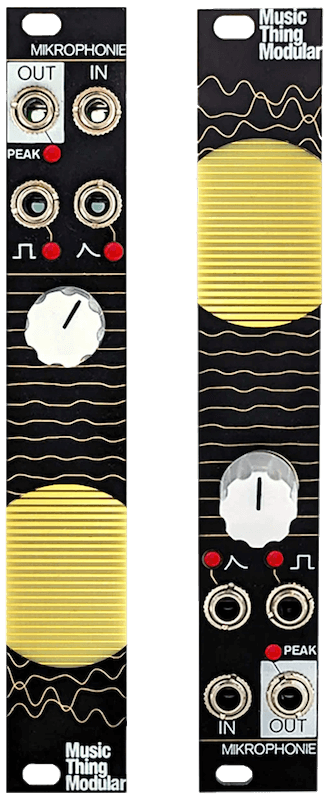
New and improved version of the classic Mikrophonie contact microphone module. This version incorporates the features of the (now discontinued) Mutable Ears module but allows you to push the preamp into dirtier territory. The kit also includes a choice of 2 x frontpanels allowing the builder to choose whether to have the scratchplate at the top or bottom of the panel.Tom Whitwell the designer of Mikrophonie describes the original thus:“Mikrophonie is a microphone preamp with a piezo contact mic built into the panel.It is an easy way to bring environmental noise and feedback into a modular system, inspired by the early days of electroacoustic music in Paris and Cologne, and by the contact microphone and phonograph cartridge experiments of John Cage, Gordon Mumma, Robert Ashley and Nicholas Collins. Here is a wonderful film from 1966 of Stockhausen & Co performing Mikrophonie 1.The panel scratchpad has quite a nice rough texture – rubbing it with a finger or a plectrum creates quite a wide range of sounds. The back of the panel is plated and grounded for shielding; the peizo microphone can either be soldered directly to the copper or stuck on with epoxy glue.”This new version of Mikrophonie improves the amplifier circuit and adds the following features from the Ears version by Emilie Gillet• An envelope follower, translating the decaying amplitude profile of a tap into an envelope CV.• A gate detector, translating taps into gate signals.• The envelope follower and gate detector can process external signals as well as the built in contact mic.Specs:• High quality Audio Amp with extended gain range over Ears.• External input bypassing the built-in contact microphone.• Envelope follower with 3 preset attack and release times (adjustable by jumper).• Gate detector with 3 preset sensitivity levels (adjustable by jumper) and +8V gate output.• Three indicator LEDs for amplifier clipping, envelope follower level and gate detector activity.This kit contains all parts to build the module, right down to the power cable and the screws. Internal contact mic is included.The module will work with a range of external contact mics including DIYed creations made from inexpensive piezo transducers, and off the shelf contact mics. We recommend to use it with LeafAudio's contact mics which are known to be very good.DIY-Kit-Type:SMD-Kit-1. This is a Do-It-Yourself kit, not an assembled module. The kit includes all parts to build the module. All SMD parts are pre-soldered, only trough-hole parts to solder. For build guide, more info, videos etc. please check the buttons below.

sold out at the moment
Eleven rhythmic outputs for wONkY drum patterns.• Pulses turns the sequence from the main Turing Machine into a series of repeating rhythmic semi-random clock signals, that are based on the main clock input.• Seven of the 11 outputs are just the binary steps of the sequence on the front panel of the main module. The other four are derived from those pulses - so when steps 1+2 are active, the 1+2 output pulses.• As with most of the Turing Machine features, it is hard to explain, but very easy and intuitive in practice: send pulses from the module to anything that takes a rhythmic pulse; envelope generators, FM Index inputs, drum modules or other sequencers. Very complex polyrhythms come easily.• Because the Pulses are all related to the main module, they randomise, lock and change with that module. With the main module's big knob at 12 o'clock, the pulses are random. At 5 o'clock, they are locked, and at 3 o'clock they will 'slip' slowly over time.• You can try out a fully operational Turing Machine + Pulses + Volts in the free VCV Rack software.• Pulses connects around the back with a 16-way ribbon cable and works with any Turing Machine (Mk2, or Mk1 with the backpack).• Pulses uses Surface Mount components but is still a very simple build for anyone who has done a bit of through hole soldering beforehand.• Here is an epic series of videos from mixolydian2010 that documents the whole build process• Here's a very old audio demo from when I was developing Pulses, which shows the kind of polyrhythmic craziness it can create.• Despite involving SMD components, Pulses is a very straightforward DIY build, that most people complete without any problems. If you get stuck, the Pulses Github Issue List or the main Turing Machine issue list are probably the best places to start.DIY-Kit-Type:SMD-Kit-2. This is a Do-It-Yourself kit, not an assembled module. The kit includes all parts to build the module. It includes SMD and through-hole parts! For build guide, more info, videos etc. please check the buttons below.
sold out at the moment
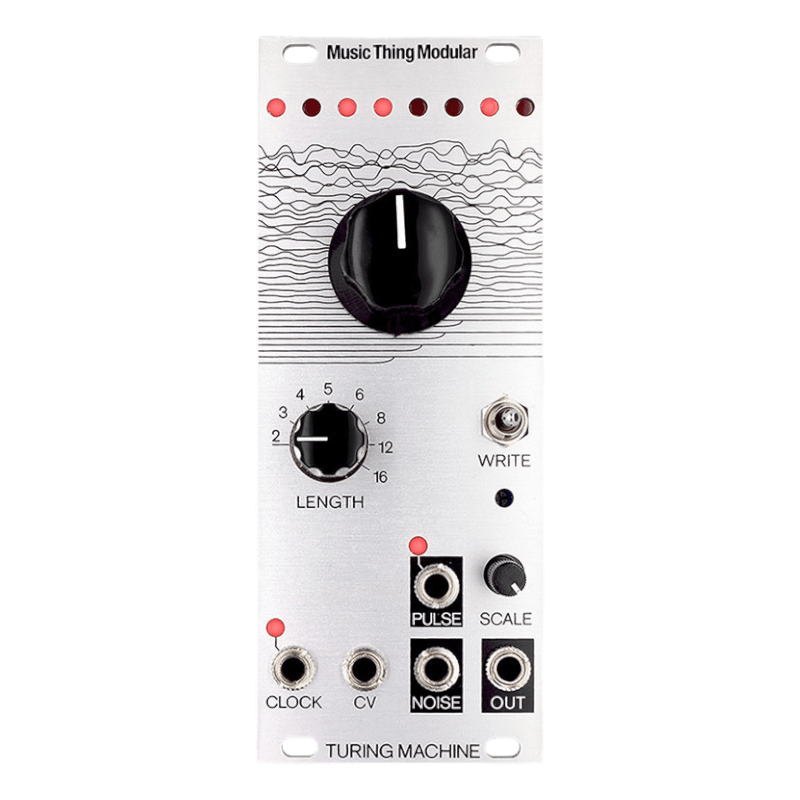
The Turing Machine is a binary sequencer based on a 16-bit shift register. Instead of precise programming, you steer its output.You can’t save or recall sequences—once changed, they’re gone.It generates clocked, stepped random control voltages (melodies, basslines, sequences) that can loop based on the length control.Since 2012, it’s been a popular Eurorack DIY project. Check #turingmachine on Instagram for demos.DivKid's 27-minute video explains it all, and here’s a 20-minute talk on its design.Sound on Sound Magazine published a nice review.Expanders connect to the module and modify sequences:• Volts: Extra voltage output controlled by five pots.• Pulses: Converts sequences into beats with 11 rhythmic outputs.• Voltages: Adds two CV outputs controlled by 8 faders.• Vactrol Mix: A matrix mixer for rhythmic audio cutting and panning.Looping is controlled by the big knob:• Noon = Random sequences.• 5 o’clock = Locked repeating sequence.• 7 o’clock = Double-length loop.• 3 or 9 o’clock = Loops with occasional changes.A free, virtual version exists in VCV Rack.Inspired by classic shift register synth circuits (Triadex Muse, Buchla 266, Noisering).Musically, it draws from 60s/70s minimalist composers like Steve Reich and Terry Riley.A Random Reading List covers its historical influences, from Marvin Minsky to Don Buchla.Open-source design has led to many clones and software versions (e.g., Mystic Circuits' Vert, VCV Rack modules, Mutable Instruments' Marbles).Despite the name, it’s not a true Turing Machine—just a looping data system.The original Mk1 documentation includes a detailed block diagram.It’s a dense but straightforward through-hole DIY build—better for experienced builders. Docs are on Thonk; troubleshooting on GitHub. DIY-Kit-Type:THT-Kit-1. This is a Do-It-Yourself kit, not an assembled module. The kit includes all parts to build the module. Only trough-hole parts to solder. Make sure to check the build guide before you buy. For build guide, more info, videos etc. please check the buttons below.

sold out at the moment
• Vactrol Mix combines four audio or CV signals into two channels, determined by the random sequence. It’s a great way to create stereo effects, complex waveforms or feedback loops.• This expander is 4 in, 2 out vactrol matrix mixer controlled by the Turing Machine, connected around the back by a 16 pin ribbon cable.• There are four inputs, for audio or CV sources. The four knobs set the level for each input. Next to each knob is a pair of LEDs. When the LED on the left is lit, the signal goes to the left output. When the LED on the right is lit, the signal goes to the right output. The LEDs are controlled by the Turing Machine module. The two outputs are both doubled (mult-ed) to make it easier to patch feedback loops.• Despite being less popular or widespread than Pulses or Volts, this is my favourite Turing Machine expander. It is a unique device that turns mundane source material into wild, unpredictable but rhythmically accessible patterns of sound. It’s a great way to create stereo effects, shifting drones, complex waveforms or feedback loops, and can be the heart of small (but chaotic) system.• Vactrols are electro-optical devices; a light shining on a light-dependent resistor. They have an extraordinary history, from powering the optical soundtracks on the first sound films in the 1920s to studio compressors, the tremolo in Fender guitar amps, and many of Don Buchla's 1970s synth designs. Modern vactrols are an LED pointing at a cadmium light dependent resistor, sealed together in a little black plastic box. Because the LDR reacts relatively slowly, the signals cut together smoothly, with no clicks or pops. Unfortunately, the cadmium in light dependent resistors is banned in Europe, so Vactrols are becoming harder to find.• Feedback is where this module gets really interesting. Try sending the (bottom) left and right outputs to your output mixer, and the (top) left and right outputs to spring reverbs or delays, patching the delay/reverb outputs back into input channels. Carefully ride the input levels, and you'll get snippets of feedback. The main clock speed can have a huge effect on feedback levels, because it takes a while to build up.• There are lots of Vactrol Mix audio examples in my Soundcloud: Twenty Minutes of Madness, Contact Mic Feedback and this ancient track recorded using the breadboard prototype.• The Vactrol Mix is DC coupled, so you can also rhythmically cut up DC sources; mix LFOs at different speeds with audio rate oscilllators, and frequency modulating a pair of oscillators using the two outputs.• This module was inspired by Grant Richter's Cadavre Exquis voltage controlled mixer, which was inspired by André Breton's surrealist game Exquisite Corpse. Richter's mixer also inspired the RxMx module by Make Noise.• Jonathan Higgins, on Facebook: 'There isn't a patch I don't use it on. People often thing you can only use it for crazy stereo percussion (which it is amazing at). But I also often patch all four outputs from the humpback filter into it for evolving stereo drones.'• The Vactrol Mix is a very straightforward through-hole DIY build. If you get stuck, the Github Issue List is probably the best place to start - remember to check closed issues as well as open ones.DIY-Kit-Type:THT-Kit-1. This is a Do-It-Yourself kit, not an assembled module. The kit includes all parts to build the module. Only trough-hole parts to solder. Make sure to check the build guide before you buy. For build guide, more info, videos etc. please check the buttons below.

available
The Workshop System is a complete modular synthesizer and audio computer – small enough to fit in a book-sized case, but packed with sound-shaping tools and educational potential. Designed for musicians, makers and tinkerers, it’s a fully modular playground for learning, composing, experimenting, and hacking.The system includes 14 analog and digital modules, ranging from vintage-style oscillators and filters to a programmable digital Computer module with swappable program cards. It works standalone inside its custom case or can be mounted in a Eurorack system (42 HP).You can use the system for crafting pure tones, exploring feedback loops, integrating guitar pedals, or writing your own firmware – the Workshop System invites hands-on discovery and creative exploration.Features:• Complete modular synth in a compact, case-mounted 42HP format• Includes 14 modules: oscillators, filters, mixer, ring mod, stompbox loop, envelope generators, and more• Powerful Computer module with RP2040 brain and reprogrammable program cards• Runs on USB-C (Power Delivery!) power (15 V) or standard Eurorack barrel input (15-25 V DC)• Works with audio sources, guitar pedals, microphones, and external MIDI/CV gear• Designed for experimentation, hacking, education – and serious music making The kit does not include:• Eurorack patch cables – we figure that many users of modular synths already have patch cables lying around – but if you’re just starting out and would like a set of short patch cables then we have a cable set available HERE• A power cable – The Workshop System has two power options: The easiest way is via USB-C PD power, but you can also use a regular 15-25 V DC barrel connection like THIS. The system will happily run from battery powerbanks and laptop adaptors. We feel that there are already enough USB-C cables in the world.DIY-Kit-Type:SMD-Kit-1. This is a Do-It-Yourself kit, not an assembled module. The kit includes all parts to build the module. All SMD parts are pre-soldered, only trough-hole parts to solder. For build guide, more info, videos etc. please check the buttons below.

available
Elmyra 2 is a 4-voice digital/analog hybrid platform for microtonal sonic exploration, capable of creating anything from lush ambient soundscapes to gritty droning textures and shrieking noises, available as a 42 HP Eurorack module or semi-modular desktop synth. With 31 modulation targets, 4 polymetric sequencers, delay, additional per-voice effects, a choice of various filters, as well as onboard LFOs and utilities, it is essentially a purpose-built small modular system in itself. A set of preset cards (included) or electronic components like capacitors or diodes can be plugged into the front panel in order to change the sound character.Features:• 4 independent voices activated by touch or CV• wavetable-based complex oscillator engine, up to 12 oscillators in total, 1V/octave compatible• chromatic mode makes chords and harmonic sounds possible, microtonal scales supported• 41 patch points• 31 modulation targets• touchpads with analog envelopes that can be used as modulation sources• resonant filter switchable between:• boomy and aggressive multimode 2-pole state variable filter (low-pass, band-pass, high-pass)• creamy 4-pole low-pass ladder filter• delay with unhealthy amounts of feedback• lo-fi reverb• analog OUCH circuit: a unique combination of destructive distortion, waveshaping and filtering• sonic character can be customised by using special preset cards (set of 4 included) or components like diodes that can be plugged into the front panel• preset cards can be used with other Neutral Labs modules• external audio can be processed via audio input• 9 per-voice modulations and effects:• unison detune• dual sub-oscillators• saturation• bitmangler• sample rate reduction• noise• high-pass filter• low-pass filter• 2 LFOs: 1 sine, 1 complex morphable• 4 sequencers with arbitrary step length per voice (up to 128), allows polymetric structures• delay time and LFOs can be clock-synced or unsynced (tap tempo is also possible)• utilities• dual attenuator/buffered multiple/voltage generator• CV summing circuit• solid bamboo wood case• boutique synth handmade in GermanyDIY-Kit-Type:SMD-Kit-1. This is a Do-It-Yourself kit, not an assembled module. The kit includes all parts to build the module. All SMD parts are pre-soldered, only trough-hole parts to solder. For build guide, more info, videos etc. please check the buttons below.