
Envelope & Modulation

only -1 left
The Dannysound Dynamics is a compressor / expander originally designed to process drums but like most processing devices, it can be used for a wide variety of applications.The module comprises of:• Compressor / Expander• Sub Bass Enhancer• 3 Band Inductor-based EQ• Harmonic ExciterThe compressor / expander section uses a discrete transistor-based circuit that allows for soft clipping when overdriven.The envelope detector is known as a feedforward type of circuit; taking it’s input from the signal before it goes to the compressor rather than after.This type of circuit is known for having fast attack times.The Sub Bass enhancer has its own compression circuit that “ducks” the initial transient. This allows the sub bass to be increased without distortionon the transient peaks increasing the overall level.There is a MIX control to allow the unprocessed signal to be mixed back in with the processed signal.The 3 band EQ is an inductor based LCR design. After trying out various EQ topologies this was the design that sounded the nicest.When overdriven it gives a nice “bite” to the sound and it has a certain characterful charm that’s hard to put into words.The controls have a response that are subtle to begin with and get more pronounced as the controls are increased.The Harmonic Exciter adds a little distortion to the high frequencies which bring out the sparkle of cymbals or the snap snare drums.The operating bandwidth can be switched between Low (snare drum snap) or High (Cymbals sparkle).There are inputs for side chaining and control with an external envelope as well as an envelope out to make the envelope detector output available to drive other modules.It also features separate inputs and outputs for the Compressor / Expander and EQ sections, so they could be used as 2 separate modules.Features:• Compressor / Expander• Sub Bass Enhancer• 3 Band Inductor-based EQ• Harmonic Exciter• Envelope In/Out• Sidechain Input• Separate In/Out for Comp/Exp and EQ sectionsDIY-Kit-Type:THT-Kit-1. This is a Do-It-Yourself kit, not an assembled module. The kit includes all parts to build the module. Only trough-hole parts to solder. Make sure to check the build guide before you buy. For build guide, more info, videos etc. please check the buttons below.

available
The EN129 Thru Zero Oscillator is an all analogue triangle-core VCO specialising in frequency modulation.Analogue through-zero FM modulation produces a wide array of timbres particularly useful for bell like or percussive sounds.Through zero linear frequency modulation can be precisely dialled in thanks to a dedicated CV input attenuator and through zero offset control.Logarithmic FM is also available via it’s own dedicated input with attenuator and both FM inputs have an LED to indicate incoming voltages.Simultaneous analogue wave outputs include: Sine, Triangle, Sawtooth, Square and Pulse wave with Pulse Width Modulation.The PWM control goes to zero at either end of it’s range, which is very useful for creating rhythmic sounds with voltage control.Furthermore the PWM control doubles up as wave shape modulation for the Sawtooth wave – gradually altering the waveform until it shifts half a cycle.The EN129 features Coarse and Fine frequency controls as well as an LFO mode. LFO range is accessed via an LED pushbutton that alsoacts as the LFO speed indicator – the button will light up when the waveform moves through its positive cycle.A new addition of a Soft Sync Input allows the phase of the oscillator to be controlled by an external oscillator for an even greater range of timbres.Features:• Soft Sync Input• Thru Zero linear FM• Logarithmic FM• Zero to zero pulse width modulation• Sawtooth wave shape modulation• Simultaneous outputs for: Sine, Triangle, Saw, Pulse & Square• Coarse & Fine controls with LFO mode• Includes power supply isolation on frequency controlsDIY-Kit-Type:THT-Kit-1. This is a Do-It-Yourself kit, not an assembled module. The kit includes all parts to build the module. Only trough-hole parts to solder. Make sure to check the build guide before you buy. For build guide, more info, videos etc. please check the buttons below.

sold out at the moment
The LOOPING VCADSR is a 4-stage envelope generator that uses a Microcontroller from Electric Druid to generate a Voltage Controllable,Loop-able Envelope. The individual parts of the Envelope (Attack, Decay, Sustain, Release and Level) can all be individually controlled via CV.This module has 3 MODES of operation:• Normal Envelope – Gate signal fires ADSR• Gated Looping Envelope – ADSR loops whilst gate signal is high.• Looping Envelope – ADSR loops regardless of gate signal.When the envelope is looping, all 5 controls affect the output. Attack and Decay operate, as one would expect.The Sustain control sets the minimum voltage the decay part of the envelope will decay to.The Release sets a release time from the end of the Sustain period to the beginning of the next cycle.When the Sustain is set to 0 you can use the Release control to add a delay between the Attack and Decay cycles.In Normal Envelope mode the Sustain CV input can be used with an LFO source to add amplitude modulation that gradually increasesas the Envelope transitions from the Attack/Decay part of the envelope into the Sustain part.The Level CV is also a useful point for amplitude modulation or can be used for Velocity Sensitivity via CV.Features:• 3 Modes of operation: Normal, Gated Loop, Constant Loop• CV over: Attack, Decay, Sustain, Release, Level• Works with GATE signals from +5V to +12V• Output CV range 0V to +10V• Based on the ENVGEN circuit design from Electric DruidDIY-Kit-Type:THT-Kit-1. This is a Do-It-Yourself kit, not an assembled module. The kit includes all parts to build the module. Only trough-hole parts to solder. Make sure to check the build guide before you buy. For build guide, more info, videos etc. please check the buttons below.
available
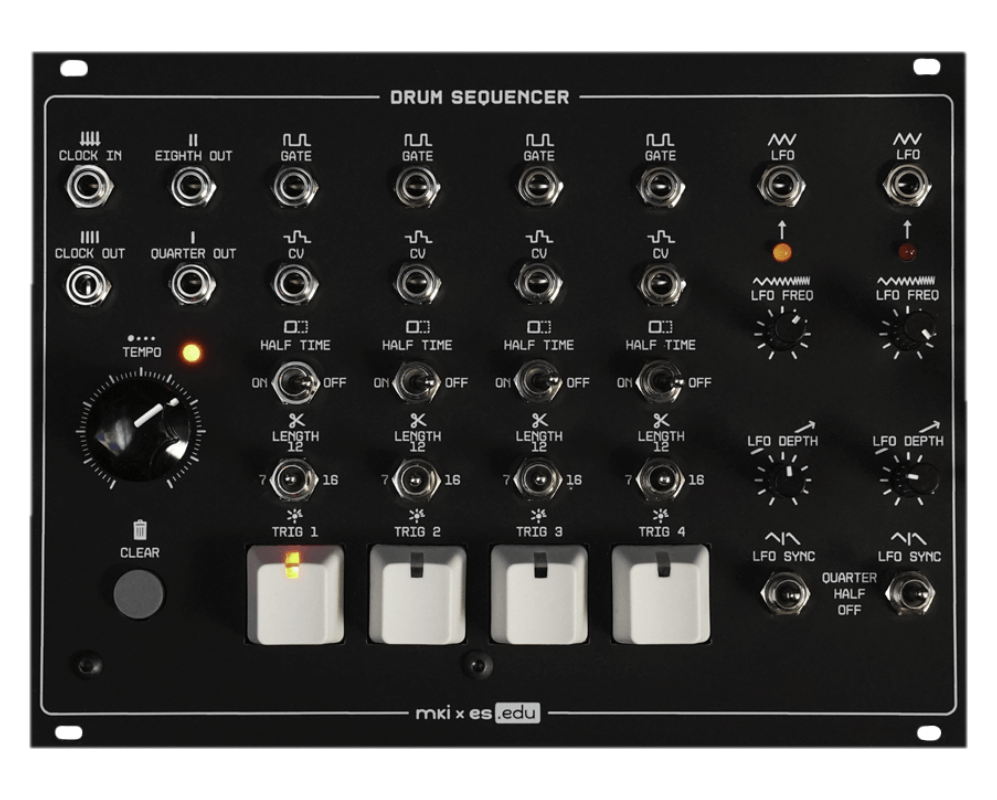
Most drum sequencers are complex machines crowded with buttons and LEDs. The mki x es.edu DIY Drum Sequencer kit takes a different path: a hands-on rhythm engine with a minimalist interface built from just a handful of logic chips. The four independent channels are programmed in real time using a single button, so patterns loop automatically, can be shortened on the fly and support half-time playback for slower, evolving grooves.Accents and dynamics are handled by synced LFOs, and a simple resistor DAC converts patterns into stepped control voltages – perfect for modulating pitch, decay, filter cutoff, or other parameters. This logic-chip sequencer delivers tactile, musical performance without relying on microcontrollers, making it an excellent DIY drum sequencer kit for learning sequencer design and sharpening soldering skills.Features:• 4 independent channels with one-button step input/removal• 16 steps per channel, individually reducible to 12 or 7• Optional half-time mode per channel• Two syncable analog LFOs for dynamic accents• Resistor-DAC output for pitch or decay modulation• Internal clock with 16th, 8th, and quarter note outputs, syncable to external gearDIY-Kit-Type:THT-Kit-1. This is a Do-It-Yourself kit, not an assembled module. The kit includes all parts to build the module. Only trough-hole parts to solder. Make sure to check the build guide before you buy. For build guide, more info, videos etc. please check the buttons below.

available
This is an easy to build Envelope Generator with a really extensive documentation and explanation of the circuit. Excellent learning kit!Many iconic sounds like the squelchy acid bass line, snappy techno kick drum, and swelling dream pop pad wouldn’t be possible if it weren’t for envelope generators. So, the next module in the mki x es.edu line is a slightly optimized ADSR envelope generator. Optimized because it has only 3 controls. With sustain on, it outputs an ASR (attack/sustain/release) envelope, but when the sustain is set to a minimum, it becomes an AD (attack/decay) envelope generator that ignores gate length; Release and Decay are controlled by the same knob. A looping function and an inverted output make the module more versatile for complex patches. The full EDU DIY system is designed to have 2 EG modules, therefore everyone aiming to build the whole system will need 2 kits.DIY-Kit-Type:THT-Kit-1. This is a Do-It-Yourself kit, not an assembled module. The kit includes all parts to build the module. Only trough-hole parts to solder. Make sure to check the build guide before you buy. For build guide, more info, videos etc. please check the buttons below.

sold out at the moment
This is the Full Kit with a wide assortment of essential components (resistors, capacitors, ICs, transistors) so you can start building right away.Get started in circuit design with MKI x ES Labor. Developed in collaboration with Dr. Shalom D. Ruben teaching professor for engineering at the University of Colorado Labor is a fully-featured circuit design playground and a powerful electronics learning tool all in one. Created with the aim of serving as a universal learning tool for electronics engineering Labor enables users to delve into various aspects of electronics design from fundamental concepts to advanced techniques. Whether you're a beginner exploring the basics or an experienced engineer honing your skills Labor provides a versatile platform for experimentation and learning. Create your own filters oscillators envelopes sequencers – and whatever else you can come up with. Or use it to learn the basics by following along with our series of educational DIY kits.Features:• a built in dual power supply producing eurorack-compatible voltages, with built-in over current protection for safe experimenting• a modular interfacing section with 16 slots for potentiometers, jacks & switches• a pulse/triangle/sine oscillator (audio & LFO range)• a multi mode envelope generator controlled by a premium push button• a buffered variable control voltage source• an output amplifier with variable gain• a dedicated headphone output and a line-level output for recording, processing and analyzing the signal• an expansion slot for installing specialized prototyping tools• a protective lid to cover a breadboard.EDU DIY Labor Full Kit includes:• LABOR• Power Supply Unit• jumper cables• array of interfacing elements like potentiometers, jack sockets, switches• commonly used components (resistors, capacitors, chips, transistors) to start building circuits straight awayNB! LABOR is a testing ground for experiments with electronic circuits and we as a manufacturer cannot by any means diagnose any issues with circuits designed on the LABOR board. We will only respond to support tickets regarding obvious malfunctions of the factory-soldered circuits on the main LABOR board. For other cases of malfunction – please consult other LABOR users/ experienced DIY kit builders on online forums, such as this one. Keep experimenting – keep trying!DIY-Kit-Type:SMD-Kit-1. This is a Do-It-Yourself kit, not an assembled module. The kit includes all parts to build the module. All SMD parts are pre-soldered, only trough-hole parts to solder. For build guide, more info, videos etc. please check the buttons below.
available
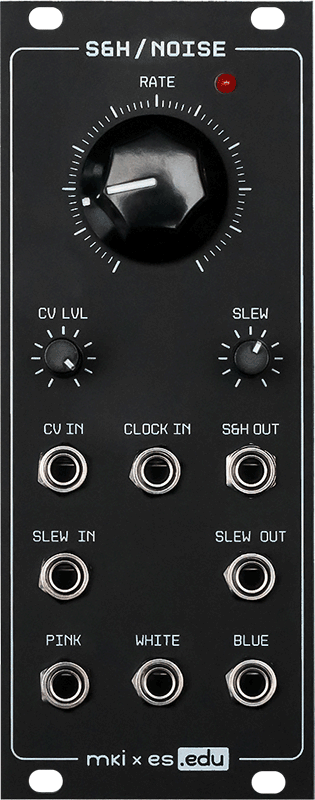
Whether you use it for self-sequencing, for adding a dash of randomness to your filter movements, or for rough analog bitcrushing, a sample & hold-circuit can often be the secret sauce that takes your patch from decent to distinctive. That’s why we came up with this super simple JFET-based implementation – and then upgraded it with a couple of extra features like an internal clock generator or a dedicated slew output. Of course, we’ll need an interesting input to sample – which is why you’ll often find sample & hold modules with an integrated noise generator. So we’ll do the same! But instead of just one noise color, we’ll throw in two extra: pink and blue in addition to the standard white noise.We – Erica Synths and Moritz Klein – have developed a series of educational DIY kits under the brand name mki x es.EDU with one specific goal in mind: to teach people with little-to-no prior experience how to design analog synthesizer circuits from scratch. What you’ll find in the box is not simply meant to be soldered together and then disappear in your rack. Instead, we want to take you through the circuit design process step by step, explaining every choice we’ve made and how it impacts the finished module.In total, we have developed 9 kits to build a fully-featured modular monosynth: a sequencer, a VCO, a wavefolder, a noise/S&H module, a mixer, a VCF, an Envelope generator, a dual VCA, and an output stereo mixer with a headphone amplifier. Additionally, an affordable eurorack case with a DIY PSU will also be available. While these kits are easy to build, we did not compromise on design and functionality. We will launch one kit every 4-6 weeks. For each kit, there is an extensive user manual (40+ pages; can be downloaded separately) that will dive deep into not only the electronics behind each circuit but also the fundamental principles of sound synthesis. We hope that the mki x es.EDU project will inspire future engineers and will contribute to the ever-growing diversity of electronic music technology.DIY-Kit-Type:THT-Kit-1. This is a Do-It-Yourself kit, not an assembled module. The kit includes all parts to build the module. Only trough-hole parts to solder. Make sure to check the build guide before you buy. For build guide, more info, videos etc. please check the buttons below.

sold out at the moment
Pack of 2 Indicator Touch Points. These ones feature a bi-polar LED inside so you can easily detect the polarity of your signal. Of course you can use them in the same way like the original Touch Points.They are assembled and no DIY.

available
5 Touch Points in black. We made them as an extension for our Touch Source, but of course you can use them without the module for wireless patching in your Eurorack system. We made them higher and smaller than comparable products or most DIY versions, so the Touch Points are easily accessible between cables and buttons in your system.

available
5 Touch Points in orange. We made them as an extension for our Touch Source, but of course you can use them without the module for wireless patching in your Eurorack system. We made them higher and smaller than comparable products or most DIY versions, so the Touch Points are easily accessible between cables and buttons in your system.

sold out at the moment
Explore wireless patching through Touch Points! Touch Source generates voltages between -10V and +10V, in the center is a touch plate with GND/0V. Place the Touch Points on any CV input of a module and connect a voltage to the Touch Point via your fingers. Or connect two Touch Points from any input to output through your body. Rule #1 is: there are no rules!Here is a review on Amazona (german) and some demo videos here and there.Touch Source includes 2 black Touch Points. Packs of 5 Touch Points are available separately in black or orange to visualize your signal flow. Packs of 2 indicator Touch Points with bi-plar LEDs are also available.The unit is pre-assembled and no DIY.

available
This is probably the fastest envelope generator in Modularland.Why? Because it is based on the fastest one. The classic Japanese modular from the seventies everyone loves.Features:• 4 control pots:Attack, Decay, Sustain, Release• 1 gate switch: triggers ADSR cycle• 1 time switch: switches between fast and slow envelope times• one normal and one inverting output jack 10V peak• standard 10 pin euro power (+12V / -12V)DIY-Kit-Type:SMD-Kit-2. This is a Do-It-Yourself kit, not an assembled module. The kit includes all parts to build the module. It includes SMD and through-hole parts! For build guide, more info, videos etc. please check the buttons below.

sold out at the moment
This is an envelope generator based on the SMD AS3310. The AS3310 is a modern recreation of the classic Curtis CEM3310 chip, used in many famous mono and poly analogue synth from the eighties. We took the best ideas from all the classic 3310 circuits and tried to squeeze the maximum from this fantastic chip. The MODE switch takes this module beyond a simple ADSR type envelope generator.It can work as:• NORMAL - a conventional ADSR envelope,• DAMPED - an ADRR piano envelope approximation• AUTO - a short gate will cycle the envelope shaper through a complete ADR envelopeIt has an additional TRIGGER input which can be used for generating multiple peak envelopes.Features:• 4 control pots:Attack, Decay, Sustain, Release• 1 gate switch: triggers ADSR cycle• 1 mode switch: Normal (ADSR),Damp (ADRR),Auto (ASR)• 1re trigger input• standard 10 pin euro power (+12V / -12V)DIY-Kit-Type:SMD-Kit-2. This is a Do-It-Yourself kit, not an assembled module. The kit includes all parts to build the module. It includes SMD and through-hole parts! For build guide, more info, videos etc. please check the buttons below.

available
This is an envelope follower based on a classic module from the seventies but with some improvements to suit modern needs.The IN signal is routed to the envelope follower circuit and also to a THRU output, so the original signal is also available for external processing.The envelope follower has three controls, a switch to select response time (fast, medium, slow), a pot to adjust GATE threshold and a pot to adjust the envelope CV level.This little module will help you shape the timbre and/or the level envelopes of your sounds. From dynamic envelope filtering to compressor like side chaining there are lots of possibilities to mangle your audio.DIY-Kit-Type:THT-Kit-1. This is a Do-It-Yourself kit, not an assembled module. The kit includes all parts to build the module. Only trough-hole parts to solder. Make sure to check the build guide before you buy. For build guide, more info, videos etc. please check the buttons below.

sold out at the moment
Lazer Phazer it's at his core 2xSystem7xx phaser with a lot of addons.It can work as a stereo phaser, as a mono BI-Phaser, as two totally independent phasers, or as a 16stages phaser in series mode. Thath's not all, the LFOs of the phasers can work idendepently or linked. In inverted mode for stereo phase galore. The feedback can be modulated by internal LFOs, external CVs or both of them in the same time.Kits have 16 x 2SK30A fet transistors matched and selected from new old stock, so the retro sound it's totally there.This module is a collaboration between Feedback Modules and CMS-LAB.DIY-Kit-Type:THT-Kit-1. This is a Do-It-Yourself kit, not an assembled module. The kit includes all parts to build the module. Only trough-hole parts to solder. Make sure to check the build guide before you buy. For build guide, more info, videos etc. please check the buttons below.

sold out at the moment
This little module is an evolution of the LFO of the famous MS monophonic synth from the seventies, adapted to Eurorack.Features:• 2 control pots for FREQUENCY and WAVEFORM• 1 FREQUENCY RANGE switch: LOW and HIGHLOW - 18mHz (55sec)- 0,7Hz (81,4sec)HIGH - 0,63Hz (1,6sec) - 24Hz (42msec)• 2 outputs: SQUARE 0/10V Vpp and TRIANGLE -5/5V Vpp• Standard 10 pin euro power (+12V / -12V)DIY-Kit-Type:SMD-Kit-2. This is a Do-It-Yourself kit, not an assembled module. The kit includes all parts to build the module. It includes SMD and through-hole parts! For build guide, more info, videos etc. please check the buttons below.

sold out at the moment
Complex analogue LFO from a vintage Japanese modular system!We injected some steroids in this LFO and the results are lots of features.Not only can you use 8 individual waveform outputs, but you can also use thealternative two linked outputs for which you can select any of the waveforms.This alternative output has a VCA so you can fade in the LFO signal in adefined duration with a potentiometer.The stair-like waveforms can be changed from 16steps, 8steps, 4steps or mangled.All of these are seasoned with cv control and waveform reset.DIY-Kit-Type:THT-Kit-1. This is a Do-It-Yourself kit, not an assembled module. The kit includes all parts to build the module. Only trough-hole parts to solder. Make sure to check the build guide before you buy. For build guide, more info, videos etc. please check the buttons below.

only 1 left
Complex analogue LFO in just 4HP!Waveshaped Square and Triangle output plus extra inverted Triangle output.Reset and gate function, multiple LFOs can be chained for complex gates and CVs.Very long LFO time on minimum setting, more than 1 min.Features:• 2X control pots for FREQUENCY and WAVEFORM• 1X FREQUENCY RANGE switch: LOW and HIGHLOW - 4,7mHz (210sec/3.5min) - 0,625Hz (1.4sec)HIGH - 183mHz (6sec) - 25Hz (40msec)• 1X MODE switch : STOP and RESET• 1X input jack : RESET• 2X outputs : SQUARE 0/10V Vpp and TRIANGLE -5V/5V VppDIY-Kit-Type:THT-Kit-1. This is a Do-It-Yourself kit, not an assembled module. The kit includes all parts to build the module. Only trough-hole parts to solder. Make sure to check the build guide before you buy. For build guide, more info, videos etc. please check the buttons below.

available
A 4 HP combined looping AR generator and triggerable LFO. Blades Of Ingenuity is a simple but surprisingly useful module consisting of two elements.Features:Attack/Release generator• one shot and looping modes• looping mode range 19 Hz to 5 secondsLow Frequency Oscillator• sawtooth/triangle/ramp switch• externally retriggerable• range from 19 Hz to 60 secondsDIY-Kit-Type:THT-Kit-1. This is a Do-It-Yourself kit, not an assembled module. The kit includes all parts to build the module. Only trough-hole parts to solder. Make sure to check the build guide before you buy. For build guide, more info, videos etc. please check the buttons below.

sold out at the moment
CEMvelope is based on the legendary ADSR section of the Sequential Circuits Pro-One monosynth, with minor adaptations to integrate it into Euro format. Smooth and snappy!It has a gate input as well as a trigger input, the trigger input works in conjunction with the gate input for multiple triggering from a suitable controller device.DIY-Kit-Type:THT-Kit-1. This is a Do-It-Yourself kit, not an assembled module. The kit includes all parts to build the module. Only trough-hole parts to solder. Make sure to check the build guide before you buy. For build guide, more info, videos etc. please check the buttons below.